Tag: Exit Desk

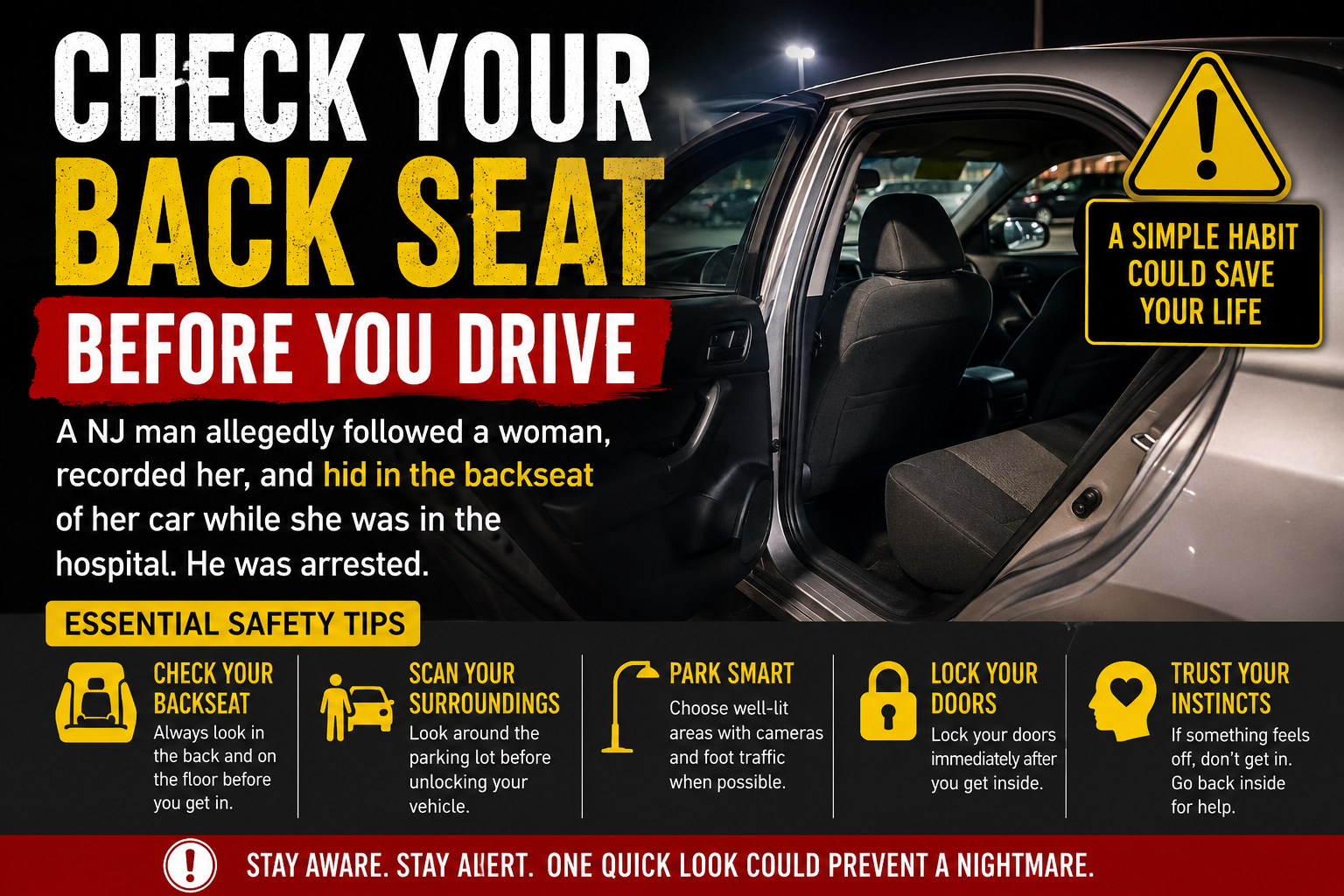
  • Why Experts Say You Should Always Check Your Back Seat Before Driving

    A disturbing stalking case out of Delaware is putting vehicle safety back in the spotlight, and it involves a 22-year-old man from Piscataway, New Jersey.

    According to Middletown, Delaware Police, the man allegedly followed a woman across state lines, secretly recorded her, and then hid in the backseat of her car while she was inside a hospital emergency room.

    Hospital security reportedly spotted him on camera sitting inside the vehicle and alerted police. He was arrested at the scene and charged with burglary and stalking.

    Thankfully, no one was physically hurt.

    But the incident has many people asking the same question: how often do we actually check our back seat before driving?

    A Simple Habit That Could Save Your Life

    Safety experts and law enforcement recommend making it a routine to check your backseat and floor area every time before getting into your vehicle.

    Criminals often target people who are distracted, exhausted, stressed, or rushing through their day. Exactly the kind of situation many people are in while leaving work, shopping centers, or hospitals.

    Taking just a few extra seconds to stay alert could potentially prevent a dangerous situation.

    Essential Vehicle Safety Tips

    Always Check Your Backseat

    Before getting in your vehicle, quickly glance into the backseat and floor area to make sure nobody is hiding inside.

    Scan Your Surroundings

    Look around the parking lot before unlocking your vehicle. Pay attention to anyone lingering nearby or acting suspiciously.

    Park Smart

    Whenever possible, choose well-lit parking spots near entrances, security cameras, or areas with steady foot traffic.

    Lock Your Doors Immediately

    As soon as you get inside your vehicle, lock the doors before checking your phone, adjusting music, or getting settled.

    Trust Your Gut

    If something feels off, listen to your instincts. Go back inside, ask security for help, or call someone you trust.

    Awareness Matters

    These safety habits take less than 10 seconds, but they can make a massive difference.

    This recent case is a sobering reminder that staying aware is not about living in fear. It’s about staying alert and protecting yourself.

    One quick glance could make all the difference.

    💬 Do you already check your backseat before driving, or is this something you’ll start doing now?

  • Why Every Small Business in New Jersey Must Use AI in 2026 — And Why Anyone Telling You Otherwise Is Setting You Up to Fail

    If you run a small business in New Jersey — a diner in Toms River, a salon in Brick, a landscaping crew in Jackson, an HVAC shop in Howell, an e-commerce side hustle in Barnegat, or even a tech startup in Jersey City — you’re facing one of the most unforgiving business climates in America.

    High taxes. High overhead. High competition.
    And the only businesses growing in this environment have one thing in common.

    They’re using AI.
    The ones who aren’t? They’re falling behind faster than they realize.

    In New Jersey, standing still isn’t neutral.
    Standing still is a slow death.

    Anyone telling you “AI is hype,” “AI is risky,” or “AI is just for big corporations” is not doing you a favor. They are either out of touch or quietly hoping you continue wasting hours on tasks AI can finish in seconds.

    Here’s the truth every NJ business owner needs to hear — loudly.


    The Businesses Ignoring AI Are Losing Ground Every Single Day

    New Jersey has more than 900,000 small businesses. Most are fighting for the same customers, the same talent pool, and the same shrinking margins.

    The difference-maker in 2026 is simple:
    AI creates time, cuts costs, and gives you a competitive edge you can’t match manually.

    Small businesses already using AI report massive gains:

    • Faster workflows
    • More accurate data
    • Stronger customer retention
    • Cheaper marketing
    • Smoother operations
    • Lower burnout
    • Higher revenue

    Businesses avoiding AI report the exact opposite — slower growth, weaker margins, and constant stress.

    In a state where competition is brutal, skipping AI isn’t a neutral choice.
    It’s a guaranteed disadvantage.

    The Productivity Gap Is Becoming a Survival Gap

    AI-powered businesses are doing the same work in half the time — sometimes a tenth of the time. Owners are replacing 10–20 hours of manual work every week with automation:

    • Scheduling
    • Customer follow-ups
    • Inventory prediction
    • Email responses
    • Social media
    • Proposals and quotes
    • Payroll prep
    • Data entry
    • Marketing research

    Businesses refusing AI still do all of this manually.
    They are exhausted.
    They are overwhelmed.
    And they are falling behind competitors who are freed up to grow, sell, and innovate.

    It’s not “fair.”
    It’s not “nice.”
    But it’s real.


    The Big Companies Already Made Their Move — And They’re Pulling Away

    Don’t believe the people saying “AI is for big corporations.”
    The big corporations didn’t just adopt AI.
    They built their entire 2026 strategy around it.

    Microsoft is automating office work.
    Amazon is automating logistics and customer service.
    Google is automating marketing and workflows.
    Banks, retailers, insurers, construction giants — all using AI to slash costs and speed up operations.

    These companies are not experimenting.
    They are deploying.
    And they are widening the gap every month.

    Small businesses that don’t adopt AI will not magically “catch up later.”
    By the time they decide to move, their competitors will be years ahead.


    The Truth: AI Isn’t Optional Anymore — It’s Oxygen

    This is not a tech trend.
    This is not a phase.
    This is not “the next social media platform.”

    AI is the new foundation of how business gets done.
    It’s the calculator, the computer, the internet — all rolled into one.

    Businesses using AI in 2026 will:

    • Save thousands on admin
    • Reduce errors
    • Look more professional
    • Respond faster
    • Market smarter
    • Make better decisions
    • Protect margins
    • Outpace competition

    Businesses ignoring AI… won’t.

    It’s that simple.


    The Harsh Reality: Your Competitors Are Already Moving

    Look around New Jersey:

    • Restaurants use AI for inventory, menu pricing, and staffing.
    • Contractors use AI for instant estimates, invoices, and job planning.
    • Salons use AI booking systems that run all day and night.
    • Retail stores use AI to optimize stocking and reduce waste.
    • Local service providers use AI for marketing and customer retention.
    • Online sellers use AI for product descriptions, ads, and demand forecasts.
    • Small law firms and accountants use AI to speed up paperwork.

    And the part nobody wants to admit:

    The customers love it.
    They love speed, clarity, and accuracy.
    They love getting answers at midnight.
    They love businesses that operate like they’re in 2026 — because they are.

    When the modern business and the old-school business compete, the modern one wins every time.


    The Bottom Line: Adopt AI or Get Outrun

    This isn’t fearmongering.
    This is the landscape.

    In New Jersey’s brutal, high-cost economy, the businesses that embrace AI will grow faster, run leaner, and survive longer.

    The businesses that don’t?
    They will get boxed out by competitors who simply operate smarter and faster.

    The risk is not using AI.
    The risk is ignoring it.

    If you’re serious about staying competitive in New Jersey — not someday, but right now — your next move is simple:

    Start using AI today.

    Even small steps compound fast. Even one automated workflow saves hours. Even one smarter decision boosts revenue.

    In this state, hesitation isn’t strategy.
    Hesitation is surrender.

    So — what’s your first AI move?

  • How to Research New Jersey Home Values: Recent Sales, Comparable Homes and Limits

    No website or AI system can reliably predict the future price of every New Jersey home. Buyers and sellers can, however, make a better-supported estimate by examining recent comparable sales, current competition and the property’s material differences.

    This guide explains a research process, not an appraisal or a forecast.

    Start with recent closed sales

    Closed transactions usually provide a stronger foundation than active listings because an asking price is not proof of market value. Look first for recent sales in the same municipality and, where relevant, the same neighborhood, development, school area or property type.

    Prioritize homes with similar:

    • Style, age and finished living area
    • Lot size and location characteristics
    • Bedroom, bathroom and parking configuration
    • Condition, renovations and major systems
    • Flood exposure, association obligations and other recurring costs

    New Jersey Realtors publishes monthly housing-market statistics that can help establish broader county and state trends. Broad statistics should not be treated as the value of a particular home.

    Separate list prices from sold prices

    Active and pending listings help show current competition, but they do not reveal the final price until a transaction closes. Price reductions, concessions and unusual financing can also affect interpretation. Verify important figures with reliable public records or a licensed real-estate professional who has access to current listing data.

    Account for differences honestly

    A nearby sale is not automatically comparable. A renovated kitchen, additional bathroom, superior location or known defect may matter, but a simple dollar adjustment generated by software is not necessarily supported. When the value matters for financing, litigation, taxation or another consequential decision, use an appropriately licensed or qualified professional.

    Understand automated valuation limits

    Automated estimates can be useful as one reference point. They may miss recent renovations, interior condition, unrecorded defects, neighborhood boundaries, unusual lots or rapidly changing inventory. Different services can produce different values because their records, models and update schedules differ.

    A general chatbot does not have guaranteed access to current multiple-listing data and should not be asked to invent comparable sales. If AI is used to organize a table of verified records, preserve the source and date for every entry and check the math independently.

    A practical research sequence

    1. Define the property’s relevant characteristics.
    2. Collect several recent, genuinely comparable closed sales.
    3. Review current competing listings separately.
    4. Note differences without pretending that every adjustment is precise.
    5. Compare the result with broader local market statistics.
    6. Get professional valuation help when the financial consequence warrants it.

    The result should be a documented range with limitations—not a confident prediction of what a home will be worth months from now.

  • New Jersey Flood Insurance Rates: Current Coverage and Cost Guide

    Update: This page previously suggested that unspecified AI tools could predict or prevent flood-insurance rate increases. That claim was not adequately supported. Flood-insurance pricing depends on the property, policy, insurer and underwriting information; no general AI chatbot can provide a reliable personalized quote or guarantee savings.

    Exit Desk now maintains one current, source-backed resource for this subject:

    Read the New Jersey Flood Insurance Guide: Coverage, Costs and Coastal Risks

    The guide explains the difference between National Flood Insurance Program and private policies, common coverage limits and exclusions, waiting periods, elevation and flood-zone information, coastal considerations, and questions to ask before buying coverage.

    Standard homeowners and renters policies generally exclude flooding. Obtain actual quotes from licensed insurance professionals or carriers and compare policy terms—not only price. FEMA maps and risk tools can help describe exposure, but they do not replace an insurer’s underwriting decision.

    This archived URL is retained so readers and existing links reach the corrected resource instead of an unsupported prediction article.

  • Renters Insurance, Flooding and Water Damage in New Jersey: What Is Covered?

    Water damage is one of the most misunderstood parts of renters insurance. A policy may cover sudden water released by a damaged pipe while excluding flooding, long-term seepage, maintenance problems and some mold losses. The cause of the water—not simply the fact that belongings became wet—can determine coverage.

    For the full coverage overview, see the New Jersey Renters Insurance Guide for 2026.

    Standard renters insurance does not cover flooding

    The New Jersey Department of Banking and Insurance states that ordinary renters policies exclude flooding, including tidal surge. The National Flood Insurance Program offers contents coverage for renters, and private flood insurance may also be available.

    Flood risk is not limited to shore communities. Heavy rain, overflowing waterways and rapid surface-water accumulation can damage ground-floor apartments, basements and storage areas in many parts of New Jersey.

    Water losses that may be covered

    A policy may cover sudden and accidental water damage from a covered event, such as an abrupt plumbing failure. Coverage still depends on the policy, cause, maintenance history and exclusions. Damage to a tenant’s belongings, additional living expenses and damage to the building can involve different policies and responsibilities.

    Common gaps

    • Flood: generally requires separate flood coverage.
    • Repeated seepage or leakage: often excluded.
    • Sewer or drain backup: may require an endorsement.
    • Mold: may be limited or excluded, particularly when tied to an excluded cause.
    • Neglect and maintenance: policies are not substitutes for repairs.
    • Property in basements or storage: may face special flood-policy limitations.

    Flood insurance for renters

    An NFIP renters policy is contents coverage; the landlord is responsible for insuring the building. FloodSmart says renters contents coverage can protect eligible belongings up to the policy limit. Building and contents coverage are separate, and limitations apply to certain property kept below the lowest elevated floor.

    Use the official FloodSmart policy information and FEMA flood maps, but remember that a property outside a mapped high-risk zone can still flood.

    What to do before a loss

    1. Ask the insurer to explain water, backup, seepage and mold exclusions.
    2. Decide whether separate flood contents coverage is appropriate.
    3. Create a photo inventory with model and serial numbers.
    4. Keep important property off basement floors when possible.
    5. Report leaks promptly in writing to the landlord.
    6. Store the policy and insurer contact information online or off-site.

    What to do after water damage

    • Protect people first and follow emergency instructions.
    • Notify the landlord and insurer promptly.
    • Photograph the source and damaged property.
    • Take reasonable steps to prevent additional damage when safe.
    • Keep receipts for temporary lodging and emergency purchases.
    • Do not discard damaged property until the insurer permits it.
    • Ask for a written coverage decision if a claim is denied.

    For policy shopping, use the NJ renters-insurance cost and quote checklist. Tenants facing a lease requirement can review the landlord requirement guide.

    Official sources

    General consumer information only. Coverage depends on the policy language and facts of the loss.

    Related reading

  • New Jersey Rejects Federal Childhood Vaccine Recommendations, Setting Its Own Path for 2026

    By Exit Desk

    New Jersey is breaking away from national guidance on childhood vaccinations, choosing not to follow a set of recommendations delivered by an advisory panel appointed earlier this year by the federal Department of Health. State officials say they will maintain their existing schedule for school-required immunizations heading into 2026.

    The move comes after months of national debate surrounding updates proposed by a federal advisory group established under the current administration. While the panel suggested adding new vaccines and adjusting timelines for several existing childhood shots, New Jersey’s public health leadership has decided the recommendations are not appropriate for statewide adoption at this time.

    State Health Officials Say Stability Matters

    According to state leaders, the priority is keeping schools, pediatricians, and families on a predictable schedule. Officials said New Jersey’s immunization requirements are already among the most comprehensive in the country and that any changes must be evaluated carefully before being introduced.

    They also noted that New Jersey’s school-entry rules have remained consistent for years, helping districts manage compliance and allowing parents to plan ahead. Sudden changes, they argued, could lead to confusion and logistical issues across districts.

    Why the State Is Taking a Slower Approach

    Health experts within the state say two main factors drove the decision:

    Ongoing review of scientific data related to the federal panel’s proposals Concerns about national inconsistency, with several states signaling they may adopt, modify, or reject different portions of the recommendations

    New Jersey officials emphasized that they remain committed to high childhood vaccination rates but want more analysis and public input before altering the school-required list.

    Pediatric Practices Watching Closely

    Doctors across the state say they are preparing for questions from families as the national discussion continues. Many pediatric practices are choosing to keep their current schedules while monitoring any future state guidance.

    Some medical groups believe New Jersey’s decision may help reduce confusion during a time of heightened attention to vaccine policy. Others expect further debate if the federal government updates its recommendations again in 2026.

    What Parents Should Know for the 2026 School Year

    For now, the rules remain exactly as they were:

    No new vaccines added for school entry No changes to existing dose timelines Medical and religious exemptions remain unchanged under current law

    Families can continue using the same documentation and scheduling used in previous years.

    Looking Ahead

    New Jersey officials say they will revisit the topic in the second half of 2026 once more data, national trends, and expert feedback are available. Until then, the state is holding firm to its current vaccination structure — a move that places New Jersey among the states choosing local control over federal recommendations.

  • 12 Real-World Factors That Shape New Jersey Turnpike Toll Prices in 2025

    Drivers across NJ say toll hikes feel constant — here’s what actually goes into the decisions.

    By Exit Desk

    The New Jersey Turnpike Authority doesn’t raise tolls at random. Families and commuters often hear about upcoming increases long before they hit, but the real reasons behind those changes aren’t always clear. From construction projects to state bond obligations, several factors drive pricing every year.

    1. Large-Scale Roadway Projects
      Major expansions, bridge repairs, and redesigns require long-term funding. Drivers say tolls often rise the year construction ramps up.
    2. Debt From Past Improvements
      The Turnpike Authority carries bonds from earlier upgrades. Commuters report that toll prices help cover ongoing repayment.
    3. Annual Operating Costs
      Plowing, repairs, maintenance crews, and lighting all require funding. Families say these everyday expenses add up across the 148-mile highway.
    4. Traffic Volume Patterns
      When traffic increases, the Authority may adjust pricing to keep flow steady. Drivers across the state say high-traffic years often precede rate reviews.
    5. Inflation and Material Costs
      Concrete, steel, and labor cost more each year. Many NJ commuters say inflation has influenced toll changes more since 2020.
    6. Weather-Driven Repairs
      Harsh winters and heavy storms create potholes and structural wear. Parents say the worst weather years usually lead to the most repairs.
    7. Technology Upgrades
      E-ZPass improvements, toll plaza redesigns, and camera systems require investment. Drivers say updates tend to happen alongside pricing changes.
    8. Revenue Needs for Safety Improvements
      Jersey barriers, lighting, guardrails, and signage are always being upgraded. Families report that these changes often appear in toll budget discussions.
    9. Vehicle Mix on the Road
      More trucks mean more wear on pavement. Commuters say truck volume is one unseen factor affecting toll decisions.
    10. Statewide Transportation Plans
      The Turnpike Authority contributes to larger projects like the Parkway or certain NJ Transit improvements. Readers tell us this sometimes influences toll adjustments.
    11. Public Hearings and Review Process
      The Authority must hold hearings before approval. NJ families say this is often when details about planned projects come out.
    12. Long-Term Planning for Future Growth
      Traffic is expected to rise over the next decade. The Authority sets prices with future expansion in mind, not just current needs.

    Once drivers understand how toll prices take shape, the yearly announcements make more sense. Many commuters say that knowing the process helps them plan budgets and travel more confidently. If you found this helpful, share it in the comments and subscribe so you don’t miss the next transportation guide.

  • What a Code Blue Means in New Jersey — And How It Helps Residents Stay Safe

    By Exit Desk

    When temperatures in New Jersey drop to dangerously low levels, a “Code Blue” alert is activated to protect people at risk from the cold. Counties open warming centers, expand outreach efforts, and coordinate emergency shelter so no one is left exposed overnight. Understanding how Code Blue works helps families, neighbors, and vulnerable residents stay safe through severe winter weather.

    A Code Blue is not triggered by storms or snow. It is issued purely based on temperature and wind chill, making it one of the state’s most important winter safety programs.

    ⸻

    What Is a Code Blue?

    A Code Blue is a statewide cold-weather emergency designation activated when temperatures fall to 32°F or below, or when wind chills create a comparable risk. Once in effect, local agencies, nonprofits, shelters, and police departments work together to offer emergency services to anyone who may be exposed to the cold.

    During a Code Blue, communities may activate:

    Overnight or daytime warming centers Outreach teams that check on unsheltered individuals Welfare checks by police and emergency services Transportation to shelters when available Distribution of blankets, food, and supplies by local nonprofits

    The mission is simple and urgent. Prevent hypothermia. Protect lives.

    ⸻

    Who Does Code Blue Help?

    Code Blue alerts are meant for anyone at risk of severe cold exposure, including:

    People experiencing homelessness Residents living in unheated or unstable housing Seniors, individuals with medical conditions, and vulnerable adults Families facing sudden heating emergencies Anyone stranded outdoors during freezing weather

    New Jersey’s program is open to all, with no requirements for ID, insurance, or residency status.

    ⸻

    How Warming Centers Work

    When Code Blue is activated, designated facilities open to provide safe, heated space and basic necessities, such as:

    Warmth and shelter Restrooms Hot drinks or simple food Blankets Overnight accommodations when available

    These centers may be located in community buildings, churches, nonprofit facilities, or county-managed sites. Capacity differs by location, and some centers may ask residents to call ahead.

    ⸻

    What To Do If You See Someone in Danger

    Code Blue relies on the community to help protect people who may be struggling outside.

    If you see someone who may need help, you can:

    Call your local police department for a welfare check. Dial NJ 2-1-1, a 24/7 hotline that connects people to warming centers and shelter resources. If the situation is life-threatening or the person is unresponsive, call 9-1-1 immediately.

    Cold exposure can become dangerous faster than many realize.

    ⸻

    Signs of Hypothermia

    Recognizing symptoms early can save a life:

    Persistent shivering Slow or slurred speech Confusion or disorientation Drowsiness or exhaustion Stumbling or poor coordination Cold, pale, or blue-tinged skin

    Anyone showing these signs needs urgent medical attention.

    ⸻

    Why Code Blue Saves Lives

    Cold weather is one of the most preventable emergency risks in New Jersey. Even brief exposure can be dangerous for children, seniors, and medically fragile individuals. Code Blue programs bring together warming centers, outreach workers, law enforcement, and nonprofits to make sure no one faces freezing temperatures alone.

    By activating quickly and coordinating across agencies, Code Blue remains one of New Jersey’s most effective winter safety measures — a vital resource that keeps communities protected through the coldest months of the year.

  • I’ve recently noticed a new wave of outrage—this time over small creators using AI. Not big brands or corporations, but local pages, scanner feeds, hobbyists, and content makers who rely on AI tools to survive the daily grind of content creation.

    And to be clear: This isn’t new. Every photo you see online is modified in some way—cropped, compressed, filtered, formatted. Even if it’s not manually edited, it’s being reprocessed by the platform itself. Instagram, Facebook, TikTok—they all change how images look before they hit your feed.

    So why the moral panic now?

    Is it because the image was obviously made by AI?

    Even if it was, why does that suddenly make it less meaningful to you? Do you scrutinize TV commercials or magazine ads or government PSA flyers for authenticity? What about the memes your aunt shares or the blurry screenshots passed around group chats?

    AI has been part of our lives far longer than most people care to admit. Spellcheck is AI. Your iPhone camera processing is AI. Excel auto-formulas are AI. Unless you’re printing a letter with a fountain pen and hand-delivering it to someone’s mailbox, you’re using computer-assisted systems.

    So here’s the deal:

    If I post a photo—real, AI-generated, or somewhere in between—my job is to give you useful or relevant content. You glance at it, get what you need, and scroll on. That’s how we consume information now.

    This isn’t about trying to win awards for photojournalism. It’s about making content digestible, clear, and quick. If the post hits the mark, great. If not, scroll. But don’t pretend that some deep betrayal has occurred just because a piece of art or visual aid was enhanced—or even created—by a computer program.

    And let’s be real: if I printed out this post, stuck it in an envelope, and mailed it to you, it would land in your trash bin with the rest of the junk mail.

    (Respect to my friends who still print publications—I’m making a point.)

  • Squid Game Season 3: A Brutal Misery Parade That Lost Its Soul

    I’m on Episode 5 of Squid Game Season 3, counting the minutes until it’s over—not because I’m hooked, but because I’m exhausted. Season 1 was a quirky, horrifying gut-punch, blending children’s games with sharp commentary on South Korea’s debt crisis. Season 2 was a messy setup, but Season 3? It’s a soulless slaughterhouse that forgot what made the show special.

    Characters I Can’t Care About

    Season 3 feels like Lost with its sprawling, disposable cast. New players like Myung-gi, a greedy crypto bro, are introduced only to be killed off or turned into caricatures. Compare that to Season 1’s Ali or Sae-byeok, whose struggles felt real. The baby player—yes, a newborn forced into the games—is a divisive twist that feels more cruel than clever. Lee Jung-jae’s Gi-hun is the exception, carrying the season’s emotional weight with a masterclass in restraint, but even he can’t save this mess.

    Games That Aren’t Games

    The twisted irony of deadly playground games is gone. Season 3 leans into raw carnage, like the “Hide and Seek” bloodbath where players hunt each other with knives in a neon maze. Unlike Season 1’s “Red Light, Green Light,” which mirrored economic desperation, these feel like video game deathmatches—stunning visuals, zero depth. The “Sky Squid Game” finale looms, but I’m bracing for more empty spectacle.

    Rules? What Rules?

    The show’s logic is crumbling. The baby’s survival defies the established voting system, and Gi-hun’s plot armor feels unearned. Season 1’s strict rules created tension; Season 3 moves goalposts to force the script forward, diluting stakes and trust.

    Subtitles That Fall Flat

    The English subtitles feel like a Google Translate afterthought, stripping the actors’ raw energy. Season 1 captured Gi-hun’s desperation; Season 3’s generic lines make me scroll my phone, only rewinding for cheap musical stings. This disconnect buries the show’s Korean cultural roots, like the SsangYong Motor strike inspiration.

    Contestants Who Don’t Belong

    These players—mentally, physically, emotionally—aren’t built for a murder Olympics. Jun-hee, pregnant and vulnerable, feels like a subway commuter tossed into a deathmatch. Even Hyun-ju’s action-hero moments can’t offset the implausible cast. Season 1’s relatable archetypes are missed.

    Final Thoughts (So Far)

    With 60.1 million views in three days, Season 3 is a cultural juggernaut, but it’s become what it once mocked: a machine churning out violence for profit. The VIPs’ cringe-worthy dialogue and cartoonish villainy only seal the deal. I’ll finish out of duty, but this feels like a betrayal of Squid Game’s heart. Am I too harsh, or did Season 3 lose you too? Drop your thoughts below.

    Will I post a finale follow-up? Maybe. Unless something flips, this is the moment Squid Game lost the plot—literally.