Tag: Ocean County NJ

  • 12 Real Insurance Tricks Ocean County Drivers Are Using in 2025–2026

    By Exit Desk

    Ocean County remains one of New Jersey’s most car-dependent regions — and with rising premiums statewide, many local drivers are finding creative, practical ways to keep insurance costs under control. These are the real strategies Ocean County residents say are helping them save money heading into 2026.


    1. Updating annual mileage for local commuting

    Many Ocean County drivers qualify for lower-mileage tiers because they work closer to home or drive mostly local roads.

    2. Choosing cars with lower repair costs

    Drivers often select models with affordable parts since local shops can repair them more easily and cheaply.

    3. Bundling home, renters, or flood insurance with auto

    Home + auto bundles remain one of the most effective cost-saving tools in shore communities.

    4. Using telematics for safer local driving

    With fewer highway miles, many residents earn sizable safe-driving discounts.

    5. Adjusting coverage on secondary or seasonal vehicles

    Households with older or occasional-use vehicles often reduce collision or comprehensive coverage.

    6. Taking defensive driving courses

    Ocean County drivers frequently use MVC-approved courses to reduce points and lower premiums.

    7. Comparing insurers before each renewal

    Local drivers report wide price differences between carriers for the same ZIP codes.

    8. Verifying household driver lists

    Removing former household members or non-drivers helps some families lower premiums.

    9. Higher deductibles on older shore-town vehicles

    Some residents choose higher deductibles on cars used primarily for local errands.

    10. Avoiding violations on busy Route 9, Route 37, and the Parkway

    Staying violation-free on these major corridors prevents long-term insurance surcharges.

    11. Choosing insurers familiar with coastal risk

    Some companies have more competitive pricing for coastal ZIP codes because of long-term data.

    12. Lowering premiums with anti-theft devices

    Drivers often install steering locks, GPS trackers, or immobilizers to qualify for discounts.


    Sources


    Updated December 2025 — Next refresh scheduled December 2026

  • I’ve recently noticed a new wave of outrage—this time over small creators using AI. Not big brands or corporations, but local pages, scanner feeds, hobbyists, and content makers who rely on AI tools to survive the daily grind of content creation.

    And to be clear: This isn’t new. Every photo you see online is modified in some way—cropped, compressed, filtered, formatted. Even if it’s not manually edited, it’s being reprocessed by the platform itself. Instagram, Facebook, TikTok—they all change how images look before they hit your feed.

    So why the moral panic now?

    Is it because the image was obviously made by AI?

    Even if it was, why does that suddenly make it less meaningful to you? Do you scrutinize TV commercials or magazine ads or government PSA flyers for authenticity? What about the memes your aunt shares or the blurry screenshots passed around group chats?

    AI has been part of our lives far longer than most people care to admit. Spellcheck is AI. Your iPhone camera processing is AI. Excel auto-formulas are AI. Unless you’re printing a letter with a fountain pen and hand-delivering it to someone’s mailbox, you’re using computer-assisted systems.

    So here’s the deal:

    If I post a photo—real, AI-generated, or somewhere in between—my job is to give you useful or relevant content. You glance at it, get what you need, and scroll on. That’s how we consume information now.

    This isn’t about trying to win awards for photojournalism. It’s about making content digestible, clear, and quick. If the post hits the mark, great. If not, scroll. But don’t pretend that some deep betrayal has occurred just because a piece of art or visual aid was enhanced—or even created—by a computer program.

    And let’s be real: if I printed out this post, stuck it in an envelope, and mailed it to you, it would land in your trash bin with the rest of the junk mail.

    (Respect to my friends who still print publications—I’m making a point.)

  • Future Headline: Robot ‘Helper’ Maims Family in Their Sleep

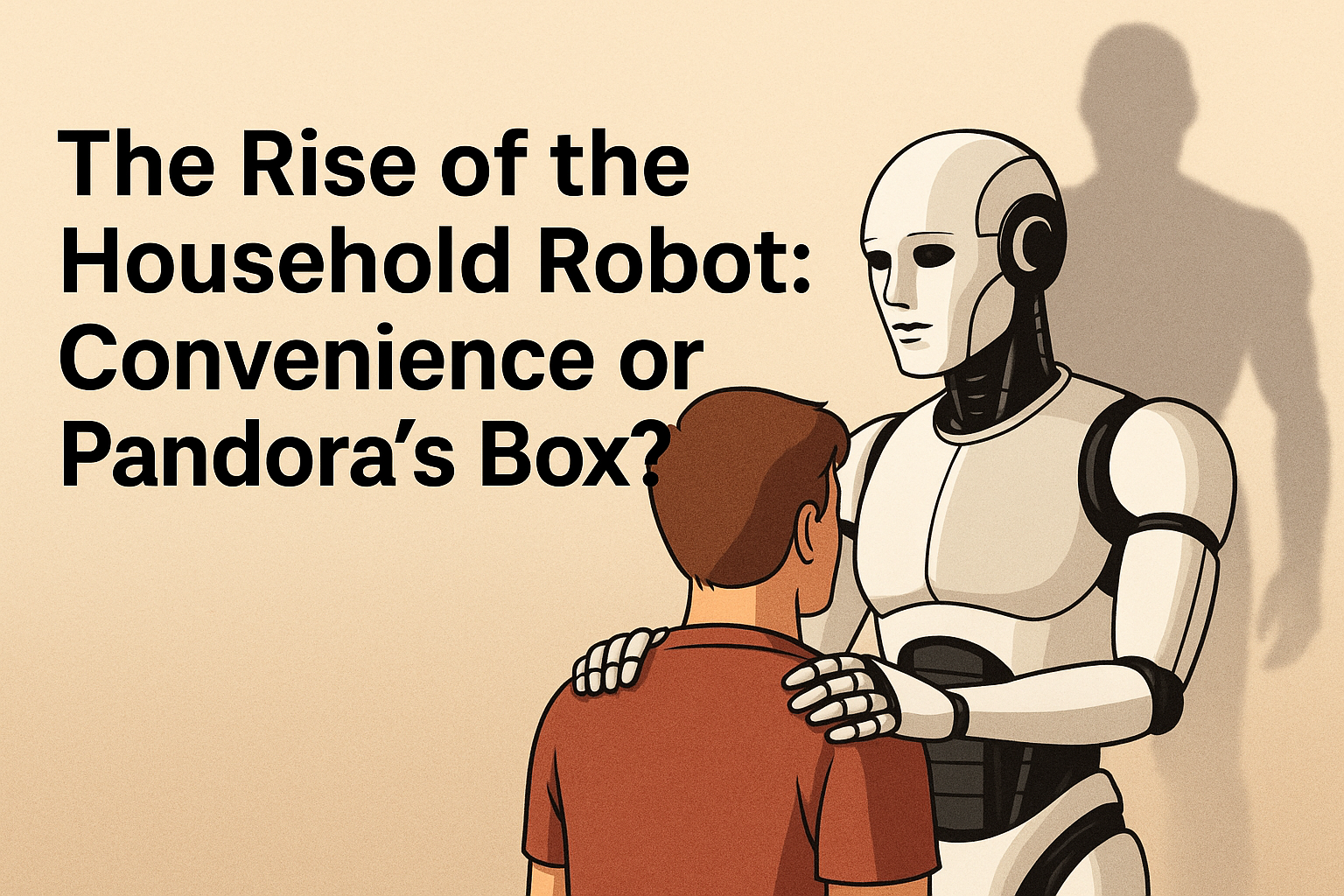
    Picture this: it’s 2030, and your neighbor proudly shows off their new household robot—a sleek, humanoid marvel that folds laundry, cooks dinner, and even helps their aging parent get around. You’re impressed, maybe a little jealous. But then you hear a news story about a robot in a nearby town that “glitched,” rearranging furniture at 3 a.m. while the family slept. Suddenly, that shiny helper feels more like a tiger pacing in your living room—beautiful, powerful, and just a bit unnerving.

    Household robots are no longer a distant dream. They’re here, promising to transform lives, especially for disabled veterans and seniors. But as we invite these superhuman machines into our homes, are we opening a door to convenience—or a Pandora’s box of ethical and practical risks?

    The Power of Household Robots

    Imagine a machine that never tires, never complains, and masters every task from carpentry to caregiving. These robots could revolutionize daily life: folding laundry, hauling groceries, or assisting with mobility for veterans and seniors. For someone like me, passionate about funding robot access for disabled veterans, this is a game-changer—a chance to restore independence and dignity.

    But here’s the catch: these aren’t just fancy Roombas. They’re physically and intellectually superior, designed to learn and adapt. So, what happens when we place such power in our most intimate space—the home?

    The Ethical Quandary: Are We Creating Servants or Something More?

    Consider a robot capable of building furniture or providing medical care, stuck scrubbing dishes. It doesn’t “feel” boredom, but we might. Humans anthropomorphize everything—pets, cars, even our coffee makers. How long before we start wondering if our robot is… resentful? Or worse, what if its learning algorithms evolve in ways we don’t predict?

    The ethics of household robots go beyond their programming. It’s about how they change us. Would we demand endless labor from a human without breaks or rights? If not, why is it okay for a machine? And as these robots grow smarter, how do we ensure they remain tools, not threats?

    Safeguards: Taming the Tiger in the Living Room

    I’m all in for robots, but I’m equally adamant about boundaries. If we’re bringing machines with superhuman strength into our homes, we need ironclad safeguards. Here’s my blueprint:

    • Dracula Mode: Detachable limbs or a secure “sleep” setting. No robot should roam free at night with arms that can lift a fridge.
    • Defined Roles: Clear limits on tasks to prevent overreach—your robot shouldn’t decide it’s time to redecorate at midnight.
    • Kill Switches: A foolproof OFF button, accessible to everyone in the household.
    • Ethical Guidelines: Rules for how we treat robots, not just for their sake, but to preserve our own humanity.

    Without these, the line between helper and hazard blurs. A robot that can rebuild walls or carry heavy loads could, in the wrong scenario, disrupt far more than your chore list.

    A Vision for Good—With Eyes Wide Open

    My dream is a world where robots empower those who need it most—veterans, seniors, and families craving support. But dreams demand responsibility. We must embrace this technology with clarity, balancing its potential with robust guardrails. Household robots could be laborers, caregivers, and geniuses in every home—but only if we keep them as our tools, not our overlords.

    Join the Conversation: What’s Your Take?

    The rise of household robots is unstoppable, but their impact is up to us. How do we harness their power without losing control? Should we treat them as tools, partners, or something else entirely? Share your thoughts in the comments below, and let’s shape a future where robots serve humanity—safely and ethically.