
Category: Transit & Getting Around

How New Jersey’s roads, transit, licensing, and traffic systems actually work, including plate data, MVC processes, and what drivers should know.

  • How to Choose an Auto Repair Shop in New Jersey: Estimates, Authorization and Consumer Rights

    New Jersey drivers have specific rights when a repair shop diagnoses or works on a vehicle. The most important protections concern written estimates, approval for additional work, detailed invoices and the return of replaced parts when requested in advance.

    This guide explains what to ask before leaving your car, what a repair shop generally must document, and how to respond when the final bill or completed work does not match what you authorized.

    Quick checklist: describe the problem in writing, request an itemized written estimate, set a maximum authorized amount, require approval before added work, ask how diagnostic charges will be handled, request replaced parts before work begins, and retain every estimate, repair order and invoice.

    Before choosing a New Jersey repair shop

    A low advertised price is not enough. Ask whether the shop regularly services your vehicle’s make, whether technicians hold relevant certifications, what diagnostic fee applies and how warranties are handled.

    • Ask people you trust about recent experiences with the specific location.
    • Check for patterns of unresolved complaints, while remembering that a complaint alone does not prove wrongdoing.
    • Read recent reviews for recurring authorization, delay or surprise-charge problems.
    • Ask whether the shop uses new, rebuilt, remanufactured or used parts and how each choice affects the warranty.
    • Confirm where the vehicle will be stored and whether storage charges can begin if pickup is delayed.
    • Get a second opinion when a repair is expensive, safety-critical or poorly explained.

    The New Jersey Division of Consumer Affairs’ Guide to Auto Repair recommends clear communication and a thorough written estimate breaking out parts and labor costs.

    Your right to an estimate

    New Jersey’s automotive-repair regulations prohibit several practices involving estimates and authorization. A shop generally must obtain an authorized estimate or follow one of the permitted alternatives before beginning covered repair work.

    A useful estimate should identify the requested service, expected parts and labor, parts type, diagnostic charges, the estimated total or maximum authorization, and how the shop will contact you if more work is needed.

    Do not sign a blank repair order. Keep a copy of every document you sign. A customer can waive a written estimate, but that should be an informed decision. If you authorize repairs up to a specific amount, treat it as a firm ceiling unless you later approve more work.

    Additional repairs require additional authorization

    A mechanic may uncover another problem after diagnosis. That does not automatically authorize a higher bill.

    New Jersey regulations prohibit charging for work or parts above an estimate without the customer’s oral or written consent obtained before the unestimated work is done or parts are supplied. When consent is oral, the shop must document authorization details and the additional parts, labor and cost.

    Ask whether the added repair is necessary now, recommended soon or optional; what changed from the original diagnosis; the new total; whether declining it makes the vehicle unsafe; and whether it changes the completion date. Record whom you spoke with, the time, what you approved and the revised maximum.

    Ask for an itemized final invoice

    Before paying, compare the invoice with the estimate and every later authorization. Look for each part and its price, labor charges, diagnostic charges, shop fees, tax and warranty terms. Ask the shop to correct unexplained discrepancies. If a warranty applies, obtain its scope and duration in writing.

    Request replaced parts before work starts

    New Jersey regulations generally require a repair dealer to return replaced parts when the customer requests them before work begins, subject to exceptions such as parts that must be returned under a warranty or exchange arrangement. Put the request on the written repair order.

    Diagnostic fees and declined repairs

    Ask about diagnostic charges before leaving the vehicle. Diagnosis can require skilled labor and equipment even if you decline the repair. If a full estimate is impossible before diagnosis or disassembly, authorize a limited diagnostic amount first and require a new estimate before repairs proceed.

    Red flags

    • Refusing to provide written terms
    • Asking you to sign a blank repair order
    • Starting substantial work before authorization
    • Adding charges that were never discussed
    • Using high-pressure warnings without explaining the diagnosis
    • Refusing to identify installed parts or warranty terms
    • Promising a low price that excludes predictable charges
    • Claiming every recommendation is immediately necessary

    If the repair does not solve the problem

    1. Return promptly and describe the remaining symptom.
    2. Bring the estimate, repair order, invoice and warranty.
    3. Ask the manager to document the complaint and proposed resolution.
    4. Do not authorize another expensive repair until the shop explains why the original diagnosis did not resolve the issue.
    5. Consider an independent inspection when safety or a major expense is involved.

    A failed repair does not automatically establish fraud. Vehicles can have multiple faults, and intermittent problems can be difficult to diagnose. Documentation helps distinguish a reasonable diagnostic process from unauthorized or deceptive conduct.

    How to file a New Jersey consumer complaint

    If you cannot resolve the dispute, retain advertisements, estimates, authorizations, invoices, photographs, messages and payment records. The New Jersey Division of Consumer Affairs provides consumer complaint options. Its Office of Consumer Protection investigates deceptive and predatory practices but does not act as a consumer’s private attorney.

    The applicable provisions appear in the Division’s Chapter 45A administrative rules. Regulations and procedures can change, so confirm current requirements with the state.

    Auto repair authorization checklist

    • Write down the symptoms and when they occur.
    • Request a written, itemized estimate.
    • Set a maximum dollar authorization.
    • Require approval before additional work.
    • Ask about diagnostic, storage and disposal charges.
    • Request replaced parts in writing before work begins.
    • Clarify parts type and warranty.
    • Keep every signed document.
    • Compare the invoice with all authorizations.

    Related New Jersey automotive guides

    Bottom line

    The safest New Jersey auto-repair transaction is documented from beginning to end. A reputable shop should explain the diagnosis, provide a written estimate, obtain authorization for additional work and provide an understandable final invoice.

    This article provides general consumer information and is not legal advice. For current requirements or help with a dispute, consult the New Jersey Division of Consumer Affairs or a qualified attorney.
  • Towed in New Jersey? Private-Property Towing Rights, Fees and Complaints

    If your vehicle is towed from a New Jersey apartment complex, shopping center or other private property without your consent, state rules govern signage, towing-company conduct, storage, billing and potentially unreasonable fees.

    This guide explains what to document, what a towing company’s bill should show and how to challenge a questionable private-property or other non-consensual tow.

    Start by documenting the location

    Photograph every vehicular entrance, nearby parking signs, pavement markings and the exact space where the vehicle was parked. Save receipts, messages and any parking permit. Note when you discovered the tow and when you contacted the storage facility.

    Required private-property towing signs

    Under New Jersey’s private-property towing regulations, an unattended vehicle generally cannot be removed without the owner’s consent unless requirements are satisfied, including a written towing agreement and conspicuous signs at vehicular entrances.

    The regulations specify signs at least 36 inches high and 36 inches wide stating the authorized parking purposes and times, that unauthorized vehicles will be towed at the owner’s expense, the towing company’s name and contact information, towing and storage charges, the storage-facility address and redemption hours, and Consumer Affairs contact information.

    Exceptions and fact-specific rules can apply, so missing or unclear signage should be documented rather than treated as an automatic guarantee that the tow will be reversed.

    If the truck has not removed the vehicle

    New Jersey consumer guidance says a towing company may not refuse to release a vehicle that has been hooked or lifted but has not actually been removed from the private property when the owner requests release. Ask what fee, if any, is being demanded and obtain a receipt.

    What the bill should include

    A private-property or other non-consensual towing bill should identify the services performed. State regulations require the bill to include the time the vehicle was delivered to the storage facility. A flat-fee bill must enumerate the towing services actually performed.

    Before paying, ask for an itemized bill showing:

    • Basic tow charge
    • Mileage or other authorized services
    • Storage dates and charges
    • Administrative or after-hours charges
    • Taxes, if applicable
    • The delivery time at the storage facility

    How New Jersey evaluates unreasonable fees

    Under N.J.A.C. 13:45A-31.5, a private-property or other non-consensual towing or storage fee is presumed unreasonable in specified circumstances, including when it is more than 25% above what the company charges for the same consensual service or more than 50% above comparable non-consensual charges by other facilities in the municipality. A municipal maximum can also control.

    Those comparisons can require evidence. Ask for the municipal towing ordinance or fee schedule and retain the disputed invoice.

    Retrieving the vehicle

    Contact the storage facility promptly because storage charges can accumulate. Ask what identification, ownership documentation and payment methods are accepted. Record any refusal to provide an itemized bill or reasonable opportunity to retrieve the vehicle.

    Paying to prevent additional storage charges does not necessarily resolve whether a charge was lawful. Keep the receipt and state in writing that you dispute specific charges when appropriate.

    How to dispute a tow

    1. Ask the towing company for an itemized bill and written explanation.
    2. Request the applicable municipal fee schedule.
    3. Contact the property owner or manager for the towing authorization and parking policy.
    4. Preserve photographs of signs and entrances.
    5. Make a written good-faith request to resolve disputed fees.
    6. If unresolved, file a consumer complaint with supporting documents.

    The New Jersey Division of Consumer Affairs publishes the private-property and non-consensual towing regulations and provides consumer complaint options.

    Evidence checklist

    • Photographs of every entrance and sign
    • Parking permit or receipt
    • Location and time parked
    • Time the tow was discovered
    • Towing and storage invoice
    • Payment receipt
    • Municipal fee schedule
    • Messages with the property owner or towing company
    • Names and times of conversations

    Related New Jersey automotive guides

    Bottom line

    Act quickly to limit storage charges, but document everything. The strongest towing complaint identifies the applicable sign or fee requirement, includes photographs and invoices, and clearly explains which charge or practice is disputed.

    This article provides general consumer information and is not legal advice. Rules can change, and individual towing disputes can depend on municipal ordinances and specific facts.

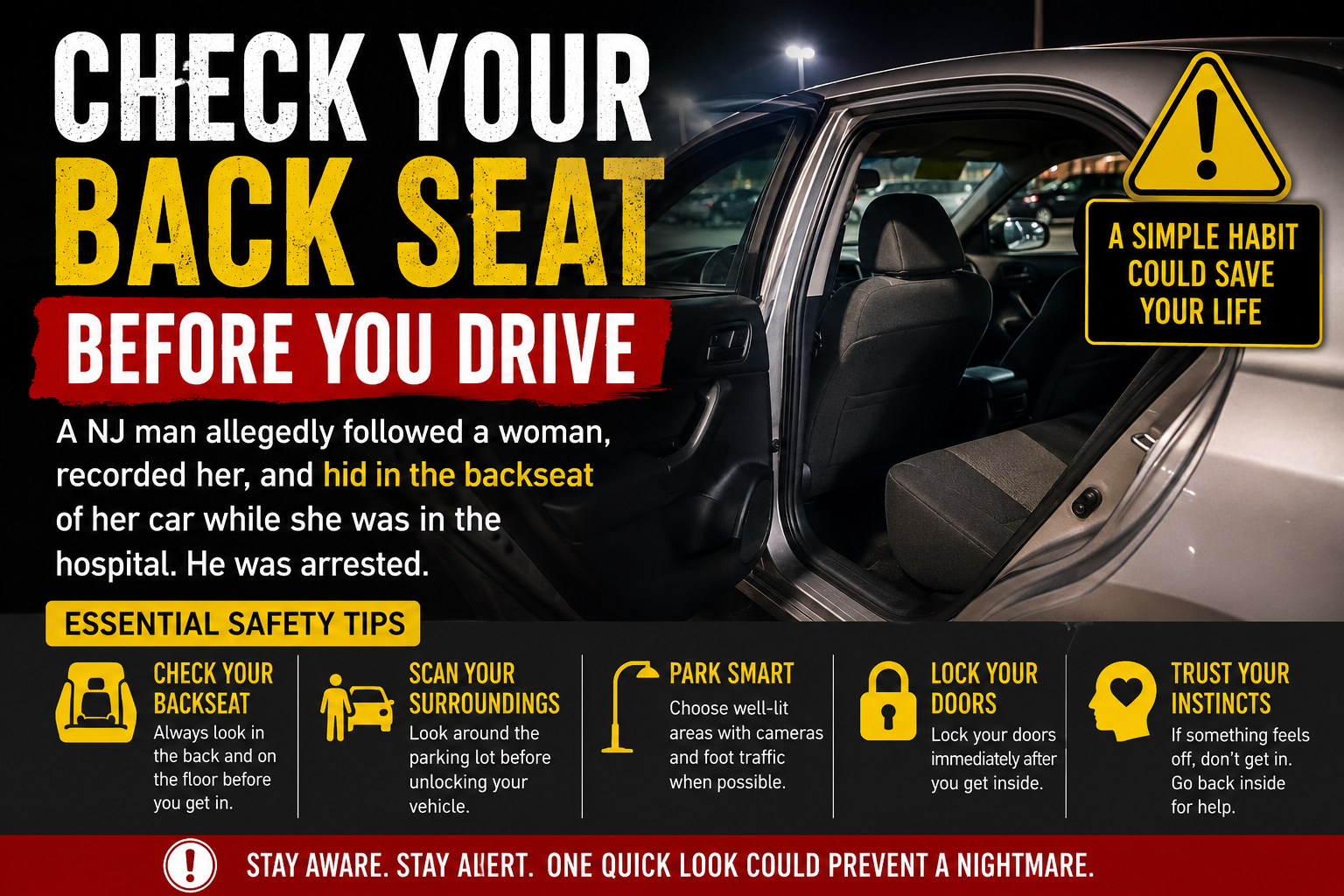
  • Why Experts Say You Should Always Check Your Back Seat Before Driving

    A disturbing stalking case out of Delaware is putting vehicle safety back in the spotlight, and it involves a 22-year-old man from Piscataway, New Jersey.

    According to Middletown, Delaware Police, the man allegedly followed a woman across state lines, secretly recorded her, and then hid in the backseat of her car while she was inside a hospital emergency room.

    Hospital security reportedly spotted him on camera sitting inside the vehicle and alerted police. He was arrested at the scene and charged with burglary and stalking.

    Thankfully, no one was physically hurt.

    But the incident has many people asking the same question: how often do we actually check our back seat before driving?

    A Simple Habit That Could Save Your Life

    Safety experts and law enforcement recommend making it a routine to check your backseat and floor area every time before getting into your vehicle.

    Criminals often target people who are distracted, exhausted, stressed, or rushing through their day. Exactly the kind of situation many people are in while leaving work, shopping centers, or hospitals.

    Taking just a few extra seconds to stay alert could potentially prevent a dangerous situation.

    Essential Vehicle Safety Tips

    Always Check Your Backseat

    Before getting in your vehicle, quickly glance into the backseat and floor area to make sure nobody is hiding inside.

    Scan Your Surroundings

    Look around the parking lot before unlocking your vehicle. Pay attention to anyone lingering nearby or acting suspiciously.

    Park Smart

    Whenever possible, choose well-lit parking spots near entrances, security cameras, or areas with steady foot traffic.

    Lock Your Doors Immediately

    As soon as you get inside your vehicle, lock the doors before checking your phone, adjusting music, or getting settled.

    Trust Your Gut

    If something feels off, listen to your instincts. Go back inside, ask security for help, or call someone you trust.

    Awareness Matters

    These safety habits take less than 10 seconds, but they can make a massive difference.

    This recent case is a sobering reminder that staying aware is not about living in fear. It’s about staying alert and protecting yourself.

    One quick glance could make all the difference.

    💬 Do you already check your backseat before driving, or is this something you’ll start doing now?

  • Why NJ Transit Feels So Unreliable

    The Real Reasons Behind Delays, Cancellations, and Rider Frustration

    (Evergreen Guide. Updated January 2026)

    If you have ever waited on an NJ Transit platform for a train that was delayed again, canceled without warning, or showed up overcrowded and uncomfortable, you are not alone.

    NJ Transit moves hundreds of thousands of riders every day. Mostly commuters heading to and from New York City. Despite its size and importance, it has developed a reputation as one of the least reliable major commuter rail systems in the country.

    This is not just bad luck or commuter exaggeration. The problems are structural, long-standing, and well documented. They come from aging infrastructure, operational dependencies, funding gaps, and system design choices that compound delays.

    Here is what is actually behind NJ Transit’s reliability issues.


    1. Aging Infrastructure and Decades of Deferred Maintenance

    Much of NJ Transit’s rail network relies on infrastructure built decades ago. In some cases, more than a century old.

    Major problem areas include:

    • Overhead catenary wires and signal systems
      These systems are highly sensitive to weather. Heat causes expansion in summer. Ice causes failures in winter. Breakdowns often cascade across multiple lines.
    • The Portal Bridge bottleneck
      The 115-year-old swing bridge over the Hackensack River is one of the worst chokepoints on the Northeast Corridor. It opens for marine traffic and frequently malfunctions.
      The Portal North Bridge replacement is underway, but early 2026 construction phases have required temporary service reductions of roughly 50 percent on some schedules. Long-term gains come with short-term pain.
    • An aging train fleet
      Many locomotives and rail cars are 30 to 50 years old. NJ Transit relies heavily on single-locomotive trains. One failure often means an entire trip is canceled. Systems with distributed power have more redundancy.

    The result is a system that experiences far more mechanical cancellations than comparable railroads.


    2. Dependence on Amtrak’s Northeast Corridor

    NJ Transit does not control its most important tracks.

    The Northeast Corridor is owned and dispatched by Amtrak. NJ Transit shares it with high-priority Amtrak services like Acela and Northeast Regional trains.

    This creates several issues:

    • Amtrak trains are often prioritized during disruptions.
    • Bottlenecks like the Hudson River tunnels magnify even small delays.
    • Signal failures, brush fires, or Amtrak equipment issues ripple directly into NJ Transit service.

    Few major commuter railroads in the U.S. are this dependent on another operator’s infrastructure. That dependency makes NJ Transit especially vulnerable to cascading delays.


    3. Chronic Underfunding and Budget Pressure

    NJ Transit’s financial struggles did not start recently. They span multiple administrations.

    Key factors include:

    • Capital funds repeatedly diverted to cover operating costs.
    • Delayed fleet replacement and infrastructure upgrades.
    • Workforce shortages, especially engineers and maintenance staff.
    • Fare increases used to stabilize budgets without corresponding service improvements.

    While recent funding efforts and federal grants have helped, the system still operates with a structural gap. Preventive maintenance and long-term planning have suffered as a result.


    4. On-Time Performance and Cancellation Reality

    Official NJ Transit data often shows on-time performance in the 80 to 90 percent range. However, that number typically excludes Amtrak-related delays.

    Independent analyses tell a different story:

    • NJ Transit experiences significantly more severe delays of 30 minutes or longer than regional peers.
    • Mechanical cancellations remain higher than comparable systems.
    • Rider satisfaction surveys consistently cite reliability and communication as the top complaints.

    For riders, the experience often feels worse than the numbers suggest because cancellations cluster during peak hours when alternatives are limited.


    5. Other Contributing Factors Riders Feel Every Day

    Several additional issues make delays feel more frustrating than they might otherwise be:

    • Weather sensitivity. Heat waves, cold snaps, and storms disproportionately impact NJ Transit.
    • Communication gaps. Riders often receive delayed or unclear updates during disruptions.
    • Overcrowding. When one train is canceled, remaining trains absorb more riders, worsening conditions.
    • Bus and light rail variability. Buses face traffic congestion, while light rail systems have their own maintenance issues.

    These factors combine to create the sense that things are always going wrong, even when the root cause is not obvious.


    What Is Being Done and What Comes Next

    There are real improvements underway:

    • New multilevel rail cars are expected to begin entering service in mid-2026.
    • Portal North Bridge and Gateway Program projects aim to remove major chokepoints.
    • Positive Train Control implementation is complete.
    • Workforce rebuilding is in progress.

    The problem is timing. These fixes take years, not months.


    Practical Tips for NJ Transit Riders

    Until reliability improves, riders can reduce frustration by:

    • Using NJ Transit alerts and real-time tracking tools.
    • Building buffer time into commutes, especially for NYC travel.
    • Knowing alternative routes such as PATH, buses, or park-and-ride options.
    • Reporting issues through official channels. Complaints do influence planning and funding decisions.

    The Bottom Line

    NJ Transit’s reliability problems are not random. They are the result of infrastructure age, shared control with Amtrak, long-term funding gaps, and system design constraints.

    The system still moves millions of people safely every year. But until major projects are completed and funding stabilizes, delays and cancellations will remain part of daily life for many riders.

    If you ride NJ Transit regularly, you are not imagining it. And you are not alone.

    What is your biggest NJ Transit pain point? Reliability, communication, overcrowding, or something else.

    For the recurring infrastructure and operating problems behind rail disruptions, see why NJ Transit trains get delayed and what riders can do.

    Related reading

  • New Jersey E-Bike Laws in 2026: License, Registration, Insurance and Helmet Rules

    New Jersey began implementing major new e-bike requirements on June 26, 2026. Riders now need to understand licensing, registration, insurance, helmet and age rules before using an electric bicycle on public roads.

    Quick answer: New Jersey requires e-bike operators to be at least 15 years old and hold either an e-bike license or a valid driver license. E-bikes must be registered with the New Jersey Motor Vehicle Commission. Insurance is required for motorized bicycles, but not for low-speed electric bicycles. Helmets are required.

    New Jersey’s two e-bike categories

    The current law distinguishes between low-speed electric bicycles and motorized bicycles.

    • Low-speed electric bicycle: a pedal-assisted bicycle whose motor provides assistance only while the rider is pedaling, up to 20 mph.
    • Motorized bicycle: a qualifying pedal bicycle with an engine or electric motor that can provide pedal assistance or throttle propulsion within the limits established by state law.

    The category matters because insurance is required for motorized bicycles but not for low-speed electric bicycles. Owners should use the vehicle’s specifications and current NJMVC definitions rather than relying only on a retailer’s Class 1, Class 2 or Class 3 label.

    License requirement

    To operate an e-bike legally in New Jersey, a rider must be at least 15 and have either a valid driver license or the appropriate e-bike license.

    Someone who already holds a valid New Jersey driver license does not need a separate e-bike license. A person without a driver license must use the NJMVC licensing process, which can include a permit, knowledge test, practice period and road test. A minor may also need parental consent.

    Registration requirement

    All covered e-bikes must be registered with NJMVC. The Commission began taking appointments for e-bike licensing and registration on June 26, 2026.

    Owners should consult NJMVC before visiting an agency because required documents, appointment procedures and vehicle-identification issues can differ. Retain the purchase receipt and all available manufacturer documentation.

    Which e-bikes need insurance?

    Motorized bicycles require insurance. Low-speed electric bicycles do not. This distinction corrects the overly broad claim that every e-bike requires liability insurance.

    Owners should confirm the vehicle’s legal classification before purchasing coverage or assuming none is necessary. An insurer may request technical specifications, including motor operation and maximum assisted speed.

    Helmet and age rules

    New Jersey requires e-bike riders to wear a helmet. Operation is prohibited for children under 15. These requirements apply even when the rider has experience using the bicycle or operates it only for short local trips.

    What riders should do now

    1. Find the manufacturer’s specifications, including motor type and assisted speed.
    2. Determine whether the vehicle is a low-speed electric bicycle or motorized bicycle under New Jersey law.
    3. Confirm the applicable NJMVC licensing process.
    4. Register the e-bike.
    5. Obtain insurance if it is classified as a motorized bicycle.
    6. Wear a helmet and comply with local riding restrictions.
    7. Carry licensing and registration documentation as directed by NJMVC.

    Official sources

    See the NJMVC e-bike implementation advisory and the Commission’s licensing and registration announcement. The underlying legislation is P.L.2025, c.285.

    Bottom line

    New Jersey’s e-bike rules are now an active compliance issue, not merely a proposed bill. The most important distinction is that every covered e-bike must be registered, while insurance depends on whether the vehicle is a motorized bicycle or a low-speed electric bicycle.

    This article provides general information, not legal advice. Vehicle classifications and administrative procedures can change; verify current requirements with NJMVC.

  • Build Your New Jersey Winter Car Emergency Kit

    What to Pack for Snow, Ice, and Stranded Situations (2026 Guide)

    Getting stuck in a New Jersey winter isn’t just inconvenient. It can turn dangerous fast.

    With overnight temperatures dipping into the 20s, black ice forming on bridges and overpasses, and occasional snow squalls even during milder winters like 2025–2026, a well-stocked car emergency kit can make the difference between a delay and a serious situation.

    Whether you’re stranded on the Garden State Parkway, I-80 through the hills of Sussex County, or a rural back road in Hunterdon County, preparation matters.

    New Jersey’s mix of urban congestion, rural stretches, and coastal exposure means winter conditions vary widely. Northern counties often see more accumulation, while black ice is a statewide threat. Here’s what experts, including NJ Office of Emergency Management and NJDOT guidance, recommend keeping in your vehicle all winter.


    Why a Winter Kit Matters in New Jersey

    Even short drives can turn into hours-long ordeals during winter storms. Events like the late-December 2025 system, which brought sleet, ice, and travel restrictions, show how quickly conditions can deteriorate.

    An emergency kit helps you stay warm, visible, and connected while waiting for help. Preparation, however, goes beyond what you pack in your trunk. Knowing how to adjust your speed, braking, and following distance on snow and black ice is just as important. We covered that in detail here:
    New Jersey winter driving safety tips for snow, ice, and cold roads
    https://exitdesk.wordpress.com/2026/01/10/new-jersey-winter-driving-safety-tips-for-snow-ice-and-cold-roads-2026/


    Essential Items for Your NJ Winter Car Emergency Kit

    Pack these items in a waterproof container or duffel bag that fits securely in your trunk.


    Warmth & Shelter

    • Blankets or sleeping bags (wool or thermal preferred, at least one per person)
    • Extra warm clothing: hat, gloves, socks, scarf
    • Hand warmers or toe warmers

    Safety & Visibility

    • Flashlight with extra batteries or a headlamp
    • Road flares or reflective warning triangles
    • Bright-colored cloth or sign to signal for help
    • Whistle

    Food, Water & Health

    • Bottled water (at least three per person)
    • Non-perishable snacks such as energy bars, nuts, or dried fruit
    • First-aid kit, including any personal medications
    • Multi-tool or knife

    Traction & Recovery

    • Kitty litter, sand, or commercial traction mats for tires on ice or snow
    • Small shovel
    • Jumper cables
    • Tow strap or chain

    Communication & Power

    • Fully charged portable phone charger or power bank
    • Car phone charger (12-volt adapter)
    • Written list of emergency numbers, including roadside assistance

    Other NJ-Specific Must-Haves

    • Ice scraper and snow brush (required by law to clear your vehicle)
    • Windshield washer fluid rated for sub-zero temperatures
    • Tire pressure gauge (cold weather lowers tire pressure)

    Quick Tips for New Jersey Drivers

    • Check your kit seasonally: Replace water and food every six months and test flashlight batteries.
    • Store smart: Keep items accessible without blocking your spare tire.
    • Know when to stay put: If stranded, run the engine for about 10 minutes each hour for heat. Crack a window slightly to prevent carbon monoxide buildup.
    • Monitor road conditions: Use 511NJ or the NJDOT app before traveling, especially on highways like I-78 and I-287 where commercial bans are common during storms.

    January 2026 Outlook

    Forecasts call for continued cold snaps through mid-January, with possible flurries or icy conditions in northern and central New Jersey. While the season may be milder overall, winter hazards remain unpredictable.

    Preparation now takes minutes. Getting caught without it can last all night.


    Stay safe out there, New Jersey. A little preparation goes a long way.

  • New Jersey Winter Driving Safety Tips for Snow, Ice, and Cold Roads (2026)

    Winter driving in New Jersey can become dangerous quickly, even on familiar roads. January temperatures often hover between 33°F and 40°F during the day, with overnight lows dropping into the 20s or colder. Snow, sleet, freezing rain, and black ice are common statewide, from Sussex County to the Jersey Shore.

    Whether you’re driving on the Garden State Parkway, commuting through Newark or Jersey City, or navigating rural highways in Warren or Hunterdon counties, winter conditions require extra preparation and caution.


    How to Prepare Your Car for Winter Driving in New Jersey

    Before driving in winter weather, New Jersey law requires drivers to remove all snow and ice from windows, mirrors, headlights, taillights, and the roof of the vehicle. Failure to do so can lead to fines and liability in an accident.

    Winter vehicle safety checklist:

    • Ice scraper and snow brush kept in the car
    • Brief warm-up period (30–60 seconds for modern engines)
    • Tire tread depth of at least 4/32 inches for snow traction
    • Winter tires recommended for northern New Jersey drivers
    • Emergency kit with blanket, flashlight, phone charger, water, food, jumper cables, and traction material

    Safe Driving Tips for Snow and Ice in New Jersey

    Snowy and icy roads demand slower speeds and smoother driving.

    • Reduce speed well below posted limits on slick roads
    • Increase following distance to 8–10 seconds
    • Use low-beam headlights during snow or reduced visibility
    • Avoid sudden braking or acceleration
    • If skidding occurs, steer in the direction you want the vehicle to go and ease off the gas
    • Never use cruise control on snowy or icy roads

    Important NJ winter driving tip: Bridges and overpasses freeze before other road surfaces. Always assume they may be icy, even if nearby roads appear clear.


    New Jersey Snow Emergency Travel Restrictions

    During major winter storms, the New Jersey Department of Transportation may impose travel restrictions to keep roads open and safe.

    Possible restrictions include:

    • Commercial vehicle bans on highways such as I-78, I-80, I-287, and others
    • Restrictions on motorcycles, RVs, and vehicles towing trailers
    • Temporary travel bans during severe storms
    • Prohibitions on parking on highway shoulders, which interferes with plowing and emergency access

    Drivers should monitor 511NJ and NJDOT alerts for real-time road conditions, closures, and storm-related restrictions.


    What to Do If You Are Stranded in Winter Weather

    If your vehicle becomes disabled or stuck during winter conditions:

    • Pull off the roadway as far as safely possible
    • Turn on hazard lights and remain inside the vehicle
    • Call for roadside assistance rather than walking in low visibility
    • Run the engine intermittently for heat and slightly crack a window to prevent carbon monoxide buildup

    January 2026 New Jersey Winter Weather Outlook

    Forecasts suggest continued cold conditions across New Jersey through mid-January 2026, with the potential for coastal winter storms later in the month. Northern and central New Jersey typically see higher snowfall totals, while freezing rain and black ice remain statewide hazards.

    If travel is not essential during winter storms, delaying your trip is often the safest option.


    Final Winter Driving Safety Reminder

    Winter driving safety in New Jersey depends on preparation, patience, and decision-making. Slowing down, giving yourself extra space, and knowing when to stay off the roads can prevent serious accidents.

  • The 15 Best Fall Foliage Drives in New Jersey for 2026

    Scenic routes, peak color timing, and local stop tips

    Fall in New Jersey delivers serious color. Northwest hills, river valleys, and even the Pine Barrens light up with reds, oranges, and golds. The easiest way to see it all is a scenic drive with room to pull off for photos, short hikes, coffee, or cider.

    This updated 2026 guide ranks the 15 best fall foliage drives in New Jersey, including when to go and what to stop for along the way.

    Peak color tip: Mid-October in North Jersey. Late October in Central and South Jersey. Check NJ Forest Service weekly foliage reports and aim for weekdays to beat crowds.


    The 15 Best Fall Foliage Drives in New Jersey

    1) Route 519. Warren County. Blairstown to Milford

    Rolling farms, covered bridges, and sweeping Delaware River views. Blairstown makes a perfect coffee stop before heading north.

    2) Old Mine Road. Delaware Water Gap National Recreation Area

    America’s oldest road winds through dense forest, waterfalls, and historic sites along the river. One of the most photogenic drives in the state.
    Delaware Water Gap National Recreation Area

    3) Route 513 and County Road 517. Hunterdon and Warren Counties

    Classic Jersey countryside through Califon and Long Valley. Expect mills, barns, and bright hillsides.

    4) Ridge Road and Skyline Drive. Ringwood area

    Panoramic overlooks of reservoirs and mountains. Pair the drive with a visit to Ringwood Manor.
    Ringwood State Park

    5) Route 23 North. Sussex County to High Point

    Climb toward New Jersey’s highest elevation for 360-degree color. Stop at the monument for views that rival New England.
    High Point State Park

    6) County Route 563 through the Pine Barrens. Chatsworth to Batsto

    Pitch pine and oak forests glow with fiery underbrush. Do not miss Batsto Village for history and photos.
    Batsto Village

    7) Hawk Mountain Road and Clinton Road. West Milford

    Remote, wooded, and dramatic. Expect overlooks and local folklore vibes that make this drive feel extra fall-ready.

    8) Palmer Road and Pleasant Hill Road. Chester and Mendham

    Stone walls, horse farms, and blazing maples. A Morris County favorite for a relaxed afternoon drive.

    9) Route 94. Vernon to Newton

    Farmland gives way to mountain views. Farm stands along the way are ideal for cider and donuts.

    10) Jenny Jump State Forest roads. Hope Township

    Twisting forest roads with quiet pull-offs near lakes and overlooks. Short hikes add big payoff.
    Jenny Jump State Forest

    11) Route 206 through Stokes State Forest. Branchville area

    Dense woods, lakes, and easy trail access. Great for combining a drive with a quick viewpoint hike.
    Stokes State Forest

    12) County Route 521. Sussex and Warren border

    A quieter rural route with river crossings and layered valley color.

    13) Allamuchy Mountain State Park loop. Allamuchy

    Deer Park Pond and shaded forest roads make this a perfect short scenic loop.
    Allamuchy Mountain State Park

    14) Route 29 along the Delaware River. Frenchtown to Lambertville

    River views, hillsides, and walkable towns. Stop in Stockton or Lambertville for lunch or shopping.
    Lambertville

    15) Cape May County backroads. Routes 47 and 550

    South Jersey surprises with colorful marsh edges and woodlands. Color arrives earlier than the north.
    Cape May County


    Why These Drives Shine in Fall

    New Jersey foliage rivals New England in key pockets. These routes balance easy driving with frequent pull-offs for photos and short walks.

    Local planning tips:

    • Pack a picnic.
    • Download offline maps. Cell service can be spotty in the north.
    • Go early for softer light and fewer cars.

    Pair your drive with apple picking, a farm stand, or a historic town stop to turn a few hours into a full fall day.

    What’s your favorite NJ foliage route? Share it in the comments.


  • AI Beach Badge & Parking Hacks for the Jersey Shore in 2026

    A day at the Jersey Shore can get expensive fast. Beach badges, parking fees, seasonal rules, and town-specific regulations vary widely and change often. In 2026, artificial intelligence is becoming a practical tool New Jersey residents use to reduce beach-day costs, avoid fines, and plan smarter trips to the shore.

    AI tools do not bypass local rules or fees. They help residents understand them clearly before heading out, saving money through better planning rather than guesswork.

    This fits into a larger trend where New Jersey residents are using AI to manage rising everyday costs and navigate complex systems more efficiently. A full statewide breakdown is available here:
    https://exitdesk.wordpress.com/2025/12/11/how-new-jersey-residents-are-using-ai-in-2026-to-beat-high-taxes-insurance-rates-and-everyday-costs/


    Why Beach Badges and Parking Are Confusing at the Jersey Shore

    Each Shore town sets its own rules for:

    • Daily, weekly, and seasonal beach badges
    • Age exemptions and residency discounts
    • Parking permit requirements
    • Metered vs. permit-only zones
    • Seasonal enforcement dates and hours

    What works in one town can result in a ticket two towns over. Even longtime residents often get caught by rule changes or seasonal shifts.

    That confusion is where AI becomes useful.


    How AI Helps NJ Residents Save on Beach Badges

    In 2026, residents are using AI to:

    • Compare badge prices across Shore towns
    • Identify free or discounted beach access windows
    • Understand age and residency exemptions
    • Track seasonal badge break-even points
    • Plan which beach makes financial sense for frequent visits

    AI helps people choose smarter, not sneakier, options.


    How AI Helps With Shore Parking Costs

    Parking tickets are one of the most common and avoidable Shore expenses. AI tools help residents:

    • Understand parking rules by town and season
    • Identify permit requirements and enforcement hours
    • Compare metered zones vs. free side streets
    • Plan arrival times that reduce parking costs
    • Avoid ticket-heavy areas during peak enforcement

    AI helps residents prepare before arriving instead of reacting after getting fined.


    Who Benefits Most From AI Shore Planning

    AI beach and parking helpers are especially useful for:

    • Families making multiple Shore trips each summer
    • Day-trippers visiting different towns
    • Parents juggling gear, kids, and parking logistics
    • Locals hosting out-of-town guests
    • Anyone tired of surprise fees and tickets

    AI doesn’t change the rules. It makes them easier to understand.


    Important Reminder About Shore Rules

    AI tools provide guidance based on publicly available information. They do not override posted signage, local ordinances, or enforcement discretion. Always follow posted beach and parking rules once on site.

    AI is best used for planning, not arguing tickets.


    Smarter Jersey Shore Days in 2026

    Beach days should be relaxing, not a math problem. In 2026, AI helps New Jersey residents enjoy the Shore with fewer surprises, lower costs, and better planning.

    By understanding badge pricing, parking rules, and town-specific differences ahead of time, residents spend less time stressing and more time enjoying the water.

    That’s the real win.


  • AI Commuter Toll & Gas Savings Route Planner for New Jersey in 2026

    New Jersey commuters know the pain. Tolls, fuel costs, congestion, and unpredictable traffic patterns can turn a routine drive into a daily financial drain. In 2026, artificial intelligence is becoming one of the most practical tools NJ residents are using to cut commuting costs without changing jobs or moving closer to work.

    AI-powered route planning tools now help commuters reduce toll expenses, lower fuel consumption, and avoid time-wasting congestion by analyzing real-world driving patterns instead of relying on static maps.

    This is part of a broader shift where New Jersey residents are using AI to navigate high everyday costs more efficiently. The full statewide breakdown is available here:
    https://exitdesk.wordpress.com/2025/12/11/how-new-jersey-residents-are-using-ai-in-2026-to-beat-high-taxes-insurance-rates-and-everyday-costs/


    Why Commuting Costs Hit New Jersey Especially Hard

    New Jersey commuters face a unique mix of cost pressures:

    • Toll-heavy highways and parkways
    • Frequent bridge and tunnel crossings
    • Dense traffic corridors near urban centers
    • Long suburban-to-city commutes
    • Rising fuel prices and variable gas station pricing

    A few extra miles or a poorly chosen route can quietly add hundreds or even thousands of dollars per year in tolls and fuel.

    Traditional GPS tools focus on speed or distance. AI tools in 2026 focus on total cost.


    How AI Route Planners Reduce Tolls and Fuel Use

    AI commuter tools analyze more than just traffic flow. They factor in:

    • Toll pricing differences by route
    • Fuel consumption based on stop-and-go traffic
    • Historical congestion patterns by time of day
    • Road types that increase fuel burn
    • Construction and seasonal slowdowns

    Instead of defaulting to the fastest route, AI can recommend routes that are slightly longer in distance but significantly cheaper in real dollars.

    For many NJ commuters, this tradeoff produces measurable savings.


    Real-World Examples of AI Commuter Savings in NJ

    New Jersey residents are using AI tools to:

    • Avoid unnecessary toll roads during peak pricing periods
    • Identify gas stations with consistently lower prices along regular routes
    • Shift departure times by minutes to avoid congestion spikes
    • Reduce idling time that increases fuel consumption
    • Compare monthly commuting costs across multiple route options

    Over a year, these small optimizations can add up to meaningful savings without changing employers or work schedules.


    Who Benefits Most From AI Commuter Planning

    AI route planning is especially useful for:

    • Daily highway commuters
    • Workers crossing county or regional boundaries
    • Commuters traveling to North Jersey, Central Jersey, or Philadelphia corridors
    • Hybrid workers with flexible schedules
    • Households with multiple commuting vehicles

    Even commuters who only drive three or four days per week often see noticeable cost reductions.


    How This Fits Into NJ’s Growing AI Cost-Savings Trend

    AI commuter tools are not being used in isolation. They are part of a larger pattern where New Jersey residents are applying AI to:

    • Household budgeting
    • Insurance comparisons
    • Property tax analysis
    • Utility cost reviews
    • Transportation and commuting expenses

    Commuting is one of the few daily costs people feel immediately. That makes AI route optimization one of the fastest ways residents see real results.


    Smarter Commuting in 2026

    New Jersey’s transportation network is not getting simpler. Tolls, congestion, and fuel costs are unlikely to drop on their own. AI gives commuters a way to adapt without sacrificing time, income, or flexibility.

    In 2026, the smartest NJ commuters are no longer just asking which route is fastest. They are asking which route costs the least over time.

    AI is finally answering that question clearly.