
Author: EXIT DESK

  • Towed in New Jersey? Private-Property Towing Rights, Fees and Complaints

    If your vehicle is towed from a New Jersey apartment complex, shopping center or other private property without your consent, state rules govern signage, towing-company conduct, storage, billing and potentially unreasonable fees.

    This guide explains what to document, what a towing company’s bill should show and how to challenge a questionable private-property or other non-consensual tow.

    Start by documenting the location

    Photograph every vehicular entrance, nearby parking signs, pavement markings and the exact space where the vehicle was parked. Save receipts, messages and any parking permit. Note when you discovered the tow and when you contacted the storage facility.

    Required private-property towing signs

    Under New Jersey’s private-property towing regulations, an unattended vehicle generally cannot be removed without the owner’s consent unless requirements are satisfied, including a written towing agreement and conspicuous signs at vehicular entrances.

    The regulations specify signs at least 36 inches high and 36 inches wide stating the authorized parking purposes and times, that unauthorized vehicles will be towed at the owner’s expense, the towing company’s name and contact information, towing and storage charges, the storage-facility address and redemption hours, and Consumer Affairs contact information.

    Exceptions and fact-specific rules can apply, so missing or unclear signage should be documented rather than treated as an automatic guarantee that the tow will be reversed.

    If the truck has not removed the vehicle

    New Jersey consumer guidance says a towing company may not refuse to release a vehicle that has been hooked or lifted but has not actually been removed from the private property when the owner requests release. Ask what fee, if any, is being demanded and obtain a receipt.

    What the bill should include

    A private-property or other non-consensual towing bill should identify the services performed. State regulations require the bill to include the time the vehicle was delivered to the storage facility. A flat-fee bill must enumerate the towing services actually performed.

    Before paying, ask for an itemized bill showing:

    • Basic tow charge
    • Mileage or other authorized services
    • Storage dates and charges
    • Administrative or after-hours charges
    • Taxes, if applicable
    • The delivery time at the storage facility

    How New Jersey evaluates unreasonable fees

    Under N.J.A.C. 13:45A-31.5, a private-property or other non-consensual towing or storage fee is presumed unreasonable in specified circumstances, including when it is more than 25% above what the company charges for the same consensual service or more than 50% above comparable non-consensual charges by other facilities in the municipality. A municipal maximum can also control.

    Those comparisons can require evidence. Ask for the municipal towing ordinance or fee schedule and retain the disputed invoice.

    Retrieving the vehicle

    Contact the storage facility promptly because storage charges can accumulate. Ask what identification, ownership documentation and payment methods are accepted. Record any refusal to provide an itemized bill or reasonable opportunity to retrieve the vehicle.

    Paying to prevent additional storage charges does not necessarily resolve whether a charge was lawful. Keep the receipt and state in writing that you dispute specific charges when appropriate.

    How to dispute a tow

    1. Ask the towing company for an itemized bill and written explanation.
    2. Request the applicable municipal fee schedule.
    3. Contact the property owner or manager for the towing authorization and parking policy.
    4. Preserve photographs of signs and entrances.
    5. Make a written good-faith request to resolve disputed fees.
    6. If unresolved, file a consumer complaint with supporting documents.

    The New Jersey Division of Consumer Affairs publishes the private-property and non-consensual towing regulations and provides consumer complaint options.

    Evidence checklist

    • Photographs of every entrance and sign
    • Parking permit or receipt
    • Location and time parked
    • Time the tow was discovered
    • Towing and storage invoice
    • Payment receipt
    • Municipal fee schedule
    • Messages with the property owner or towing company
    • Names and times of conversations

    Related New Jersey automotive guides

    Bottom line

    Act quickly to limit storage charges, but document everything. The strongest towing complaint identifies the applicable sign or fee requirement, includes photographs and invoices, and clearly explains which charge or practice is disputed.

    This article provides general consumer information and is not legal advice. Rules can change, and individual towing disputes can depend on municipal ordinances and specific facts.
  • How to Hire a Moving Company in New Jersey: License Check, Estimates and Scam Warnings

    A company moving household goods from one New Jersey address to another must be properly licensed as a public mover. Before comparing prices, consumers should verify that license, understand the estimate and identify which services or damage protection are actually included.

    1. Verify the New Jersey mover’s license

    Intrastate public movers and warehousemen are regulated by the New Jersey Division of Consumer Affairs. License types include PM for moving, PW for warehousing and PC for combined moving and warehousing.

    Use the official license-verification page or contact the Division. Match the legal business name, address and license number to the estimate. A federal USDOT number alone does not replace the required New Jersey authority for an intrastate household move.

    2. Request at least three written estimates

    New Jersey consumer guidance recommends comparing multiple licensed movers. The mover must conduct an on-site or qualifying virtual survey before calculating the estimate and must give the consumer a completed written estimate.

    Show the estimator everything: closets, attic, basement, garage, storage unit, fragile items and anything requiring disassembly, stairs, long carries or special rigging.

    Binding versus nonbinding estimates

    A binding estimate sets an agreed price for the described services and shipment, although changes requested by the customer can alter the cost. A nonbinding estimate is an approximation based on the mover’s tariff and the shipment information. Ask the mover to identify the estimate type in writing.

    Charges that should be disclosed

    • Packing and unpacking
    • Boxes and materials
    • Travel time or mileage
    • Hourly labor
    • Stairs, elevators and long carries
    • Large or unusually heavy items
    • Disassembly and reassembly
    • Storage or redelivery
    • Coverage or valuation options
    • Tolls, parking and other approved charges

    Required consumer documents

    A licensed mover must provide the state-approved “Important Notice to Consumers Using Public Movers and Warehousemen.” After selection, the mover must also issue an Order for Service at least 24 hours before the scheduled move, except in qualifying short-notice situations.

    Understand damage protection

    Do not assume the mover will pay full replacement cost for damaged property. New Jersey consumer guidance warns that, without additional coverage, required compensation may be limited to $1 per pound per article. Ask for every available protection option, price and exclusion in writing.

    Carry jewelry, cash, identity documents, medication and irreplaceable records personally rather than packing them with ordinary household goods.

    Moving-company red flags

    • No verifiable New Jersey mover license
    • Estimate issued without an in-person or qualifying virtual survey
    • Refusal to provide a completed written estimate
    • Large cash deposit or cash-only demand
    • Business name on the truck does not match the paperwork
    • Blank or incomplete documents
    • Price dramatically below every licensed competitor
    • Pressure to sign immediately
    • No physical business address
    • Threats to withhold belongings unless an undisclosed charge is paid

    Before moving day

    1. Photograph valuable furniture and electronics.
    2. Create a box and item inventory.
    3. Confirm addresses, dates, arrival window and contact numbers.
    4. Reserve parking and elevators when required.
    5. Review the estimate and Order for Service.
    6. Keep contracts and important documents with you.
    7. Confirm payment methods and final-payment conditions.

    After delivery

    Inspect goods as they arrive and note missing or damaged items promptly. The Division advises that a damage claim can be filed up to 90 days after the move, but consumers should notify the mover immediately and follow the contract’s written claim procedure.

    Interstate moves

    A move crossing state lines involves federal requirements in addition to any applicable state rules. Verify the company through the Federal Motor Carrier Safety Administration and review federal consumer materials for interstate household-goods moves.

    Official resources

    General consumer information only. Verify current licensing and requirements with the New Jersey Division of Consumer Affairs and federal regulators when applicable.

  • NJ Mortgage Assistance and Foreclosure Help in 2026: ERMA and Free Counseling

    New Jersey homeowners behind on a mortgage—or expecting to miss a payment—should contact the mortgage servicer and a free housing counselor before paying a foreclosure-rescue company. State programs can help eligible households with arrears, housing charges, loss mitigation and court mediation.

    Emergency Rescue Mortgage Assistance

    NJHMFA’s Emergency Rescue Mortgage Assistance program can provide qualifying households with up to $75,000. Eligible uses may include mortgage reinstatement, escrow shortages, delinquent property taxes, HOA dues, municipal or tax liens, principal and interest, taxes and homeowners insurance.

    ERMA is funded through the federal Homeowner Assistance Fund and requires a qualifying COVID-19-related financial hardship. Funding is finite, so homeowners must verify that applications remain available before relying on the program.

    Basic ERMA eligibility

    • Own and occupy an eligible New Jersey one- to four-unit primary residence.
    • Have experienced a qualifying COVID-19-related financial hardship after January 20, 2020.
    • Be unable to remain current on eligible housing expenses.
    • Meet the program’s household-income limits.
    • Provide required mortgage, income, identity and tax-verification documents.

    Documents homeowners may need

    • Government-issued identification for borrowers and spouses
    • Recent income statements
    • Asset attestation
    • Signed IRS Form 4506-C
    • Current statements for every mortgage
    • Property-tax, HOA or lien records when assistance is requested
    • Tax returns for self-employed applicants or households reporting rental income
    • Proof of the qualifying financial hardship

    Free foreclosure-prevention counseling

    NJHMFA’s Foreclosure Mediation Assistance Program provides no-cost counseling to owner-occupants who are behind or in danger of default. A homeowner does not have to wait for a foreclosure complaint before requesting pre-foreclosure counseling.

    A counselor can help review the budget, prepare an action plan, organize documents, communicate with the servicer and evaluate available loss-mitigation options.

    New Jersey foreclosure mediation

    Homeowners already served with a residential foreclosure complaint may qualify for court mediation. The Judiciary generally requires a mediation request within 60 days after service unless a court order permits otherwise. The homeowner must occupy the property, the borrowers must agree to participate and bankruptcy can affect eligibility.

    What to do after missing a payment

    1. Open every servicer and court notice.
    2. Call the mortgage servicer’s loss-mitigation department.
    3. Request a written list of available options and documents.
    4. Contact an NJHMFA-approved housing counselor.
    5. Check current ERMA eligibility and funding status.
    6. Submit complete applications and retain confirmation.
    7. Respond promptly to requests for missing information.
    8. Consult a qualified New Jersey attorney when litigation, bankruptcy or disputed servicing is involved.

    Possible servicer options

    • Repayment plan
    • Temporary forbearance
    • Loan modification
    • Partial claim or deferral
    • Reinstatement assistance
    • Short sale or deed-in-lieu when retaining the home is not feasible

    Availability depends on the mortgage owner, insurer, program and household circumstances. Do not stop paying or ignore a notice based on generic online advice.

    Foreclosure-rescue scam warnings

    • Upfront fees for a guaranteed modification
    • Instructions to stop communicating with the servicer
    • Requests to send mortgage payments to a third party
    • Pressure to sign over the deed or ownership interest
    • Promises to erase a foreclosure through secret filings
    • Impersonation of NJHMFA, HUD or the mortgage company

    NJHMFA emphasizes that legitimate foreclosure-prevention counseling is available without a fee.

    Official resources

    General information only, not legal or financial advice. Programs, funding and deadlines can change. Verify availability with NJHMFA, the servicer and qualified professionals.

  • How to Hire a Home Improvement Contractor in New Jersey: Registration, Contracts and Red Flags

    Hiring a contractor in New Jersey should begin with registration, insurance and a detailed written contract—not with the lowest verbal estimate. State rules give homeowners useful protections, but those protections work best when the homeowner verifies the business and documents the project before paying.

    1. Verify New Jersey registration

    Most businesses selling or performing home improvements in New Jersey must register annually with the Division of Consumer Affairs unless a statutory exemption applies. Registration numbers generally begin with 13VH and must appear in advertisements, business documents, contracts and commercial vehicles.

    Search the Division’s official records and confirm that the business name on the registration matches the estimate and contract. Registration is not a quality guarantee, but an expired, missing or mismatched record is a serious warning.

    2. Check complaints and legal action

    Contact the New Jersey Division of Consumer Affairs to ask whether the business has been the subject of consumer complaints or state action. Also check court records, references and recent reviews, while remembering that online ratings can be manipulated.

    3. Verify liability insurance

    Request the contractor’s certificate and declarations information, then contact the insurer or agent independently to confirm that coverage is current. Check the named business, effective dates and limits. A certificate alone can be outdated or altered.

    4. Get multiple written estimates

    Ask each contractor to quote the same scope, materials and assumptions. A low estimate that omits demolition, disposal, permits, preparation or finish work is not truly comparable.

    5. Require a written contract for projects over $500

    New Jersey requires a detailed written contract for home-improvement work costing more than $500. The contract should include the contractor’s legal name, business address and registration number; start and completion dates; a description of the work; materials; total price or pricing method; and required consumer information.

    All material changes should be written and signed. Do not rely on text messages or verbal promises to redefine a major scope or price.

    6. Check permits and licensed trades

    Confirm who will obtain municipal permits and schedule inspections. Electrical, plumbing and other regulated work may require properly licensed professionals in addition to a home-improvement contractor registration. Ask for the names and credentials of subcontractors.

    7. Use a milestone payment schedule

    A contractor may request a reasonable deposit, but homeowners should be cautious about large upfront payments or demands for cash. Tie later payments to completed work, installed materials and required inspections. New Jersey rules prohibit demanding final payment before work is completed according to the contract.

    8. Understand the cancellation provision

    New Jersey consumer guidance explains that many home-improvement contracts can be cancelled before midnight of the third business day after the consumer receives the contract. Follow the contract and state instructions precisely and send cancellation in writing.

    9. Document the work

    • Keep estimates, contracts, change orders and receipts.
    • Photograph conditions before, during and after the project.
    • Record product names, colors and model numbers.
    • Keep permits, inspection approvals and warranties.
    • Confirm disposal, cleanup and lien-related paperwork.
    • Communicate important decisions in writing.

    Contractor red flags

    • Door-to-door pressure after a storm
    • No New Jersey registration number
    • A business name that does not match state records
    • Refusal to provide insurance information
    • Cash-only demands
    • A large upfront payment without a clear reason
    • No written contract for a project over $500
    • Requests to put permits in the homeowner’s name without explanation
    • Unusually vague materials or scope
    • Pressure to sign immediately

    If a project goes wrong

    1. Document the problem and contract requirements.
    2. Notify the contractor in writing and request a specific correction.
    3. Do not make final payment before contract completion.
    4. Contact the municipal construction office for permit or inspection issues.
    5. File a complaint with the Division of Consumer Affairs when appropriate.
    6. Consult a qualified New Jersey attorney for substantial losses, liens or contract disputes.

    Official New Jersey resources

    This article provides general consumer information, not legal advice. Registration, licensing, permit and contract requirements depend on the work and circumstances. Verify current rules with the relevant New Jersey agency and municipality.

    Related reading

  • How to Appeal a Property Tax Assessment in New Jersey: Deadlines and Evidence

    A New Jersey property-tax appeal challenges the property’s assessment, not the tax rate or the amount of the municipal budget. To succeed, an owner generally must show that the assessed value is unreasonable compared with the property’s true market value and the municipality’s applicable assessment ratio.

    Key filing deadlines

    • Most municipalities: April 1, or 45 days after the bulk mailing of assessment notices, whichever is later.
    • Municipal revaluation or reassessment: generally May 1.
    • Burlington, Gloucester and Monmouth Counties: January 15 under the alternative assessment calendar, subject to the notice-mailing rule.
    • County-board judgment appeal: generally within 45 days of the judgment.

    An appeal must be received by the deadline; a postmark may not be sufficient. Confirm the current date with the county tax board because local mailing dates and special circumstances can affect it.

    Assessment versus market value

    The assessment printed on a tax notice may not equal current market value. Many municipalities apply an equalization ratio. The state’s “common level range” generally extends 15% above and below the district’s average ratio. An appeal needs to address the relationship among assessed value, market value and that range.

    Evidence that can support an appeal

    • Recent comparable sales near the statutory valuation date
    • An appraisal prepared for the relevant tax year
    • Accurate property records showing incorrect square footage, condition or features
    • Photographs and repair estimates documenting material condition issues
    • Income and expense evidence for qualifying income-producing property

    Listing prices, tax bills from neighboring homes and broad automated estimates are usually weaker than verified sales adjusted for material differences.

    How to choose comparable sales

    • Use sales close to the assessing date.
    • Prefer the same neighborhood or competitive market.
    • Match property type, size, age, lot and condition.
    • Explain differences instead of ignoring them.
    • Verify deed and sale information from reliable records.
    • Avoid relying only on distressed or non-arm’s-length transfers.

    Filing with the county tax board

    1. Review the assessment notice and property record card.
    2. Confirm the municipality’s filing deadline.
    3. Calculate the implied market value using the applicable ratio.
    4. Collect comparable evidence.
    5. Complete Form A-1 and the comparable-sale form when required.
    6. Pay the filing fee.
    7. Serve required copies on the municipal assessor and clerk.
    8. Prepare concise testimony for the hearing.

    Direct Tax Court filing

    When an assessment exceeds $1 million, the owner may have the option to file directly with the Tax Court of New Jersey. Added or omitted assessments have separate thresholds and procedures. Direct court litigation involves formal rules and can justify professional legal or appraisal assistance.

    What happens at the hearing?

    The assessment carries a presumption of correctness. The taxpayer presents evidence and explains the requested value. The municipality may present its own evidence or challenge the comparables. The county board can affirm, increase or decrease the assessment.

    Risks and practical limits

    • An appeal can result in no change.
    • The assessment can potentially increase if evidence supports a higher value.
    • A lower assessment does not necessarily produce an identical percentage reduction in the final bill.
    • Municipal tax rates can change after an appeal.
    • Successful appeals generally affect the appealed tax year, not every future year automatically.

    Do not use AI as evidence

    AI can help organize questions or explain terminology, but it cannot replace verified comparable sales, an appraisal or admissible records. Never file invented sales, estimated values without sources or confidential records generated by a chatbot.

    Official resources

    General information only, not legal or tax advice. Deadlines and procedures are strict. Verify the current requirements with the county tax board or a qualified New Jersey professional.

    Related New Jersey property-tax guides

  • New Jersey Flood Insurance Guide: Coverage, Costs and Coastal Risks

    New Jersey Flood Insurance Guide: Coverage, Costs and Coastal Risks

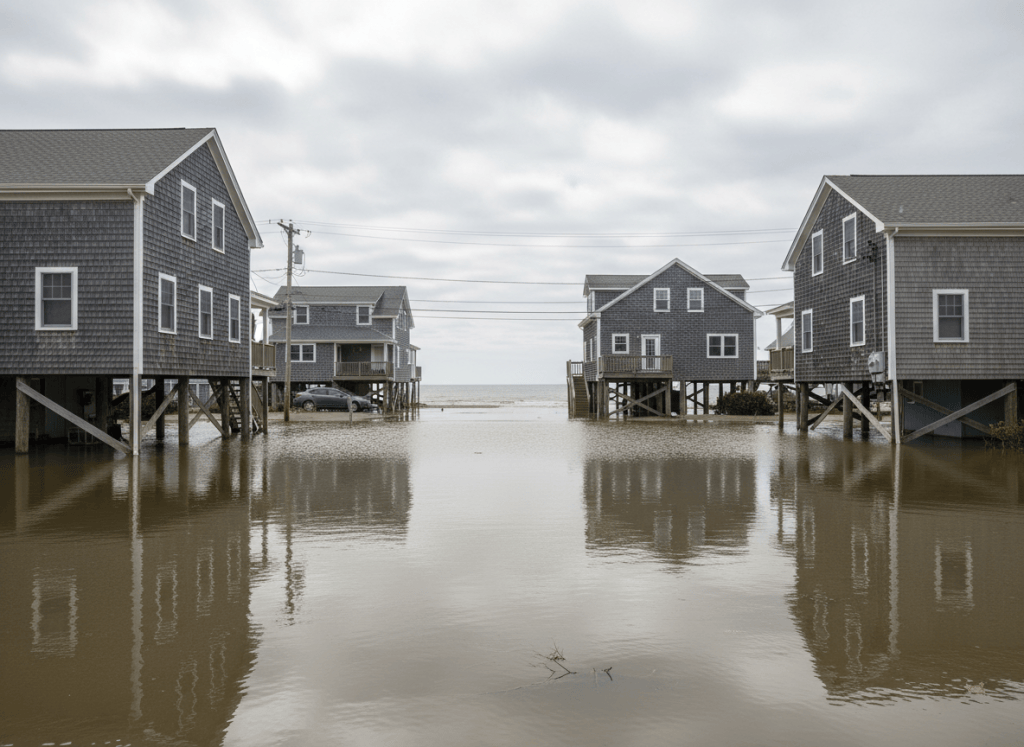
    Standard homeowners, renters and condominium policies do not cover flood damage. In New Jersey, separate flood insurance can matter far beyond the Shore because heavy rain, river overflow, tidal water and rapid surface runoff can affect properties outside the highest-risk mapped zones.

    What counts as flood?

    Flood insurance addresses qualifying inundation from overflowing inland or tidal waters, unusual and rapid accumulation of surface water and certain mudflows or shoreline erosion. A burst pipe inside one home is generally a different type of water loss and may be handled under a homeowners or renters policy.

    What NFIP building coverage can protect

    • Foundation walls and anchorage systems
    • Electrical and plumbing systems
    • Furnaces and water heaters
    • Central air-conditioning equipment
    • Built-in appliances
    • Permanently installed cabinets and flooring
    • Certain detached-garage coverage

    What contents coverage can protect

    • Furniture and clothing
    • Electronics
    • Portable appliances
    • Washers and dryers
    • Window air conditioners
    • Certain rugs and artwork, subject to limits

    Homeowners can purchase building and contents coverage. Renters generally purchase contents coverage because the landlord insures the building. Building and contents coverage have separate limits and deductibles.

    What flood insurance does not cover

    • Temporary housing and additional living expenses
    • Most vehicles
    • Currency and many valuable papers
    • Financial losses from business interruption
    • Earth movement even when associated with water
    • Moisture or mold that could have been prevented
    • Some property and improvements below the lowest elevated floor

    NFIP limits

    NFIP residential policies generally offer up to $250,000 of building coverage and up to $100,000 of contents coverage for homeowners. Renters can purchase contents coverage up to $100,000. Higher-value properties may need excess or private flood insurance.

    The 30-day waiting period

    NFIP coverage normally takes effect 30 days after purchase. Exceptions include coverage purchased in connection with making, increasing, extending or renewing a mortgage; certain policy changes at renewal; newly designated high-risk zones; and qualifying wildfire-related flooding.

    Waiting until a hurricane is approaching is generally too late.

    Do properties outside a high-risk zone need coverage?

    A lender may require flood insurance for certain mapped zones, but lender requirements do not identify every meaningful risk. Flooding can occur outside high-risk areas. Review FEMA maps, local drainage and prior-loss information, elevation and the property’s surroundings.

    NFIP versus private flood insurance

    Private policies may offer different limits, pricing, waiting periods and coverage features. Compare definitions, exclusions, loss settlement, additional living expenses, basement limitations, deductibles and cancellation or nonrenewal conditions. Confirm that a mortgage lender accepts the selected policy.

    Ways to reduce flood risk and cost

    • Obtain an elevation certificate when useful.
    • Elevate utilities and mechanical equipment.
    • Install compliant flood vents.
    • Use flood-resistant materials in exposed areas.
    • Protect important contents above likely water levels.
    • Maintain drainage and sump systems.
    • Review community mitigation and rating information.

    Questions before buying

    • What flood definition applies?
    • Are building and contents both covered?
    • What are the separate deductibles?
    • How are basement contents treated?
    • Is replacement cost or actual cash value used?
    • Are temporary housing costs covered?
    • When does the policy begin?
    • Will the lender accept the policy?

    Official resources

    General consumer information only. Coverage depends on the policy and property. Verify current terms with the insurer, NFIP and lender.

  • NJ First-Time Homebuyer Programs in 2026: Mortgages and Down-Payment Assistance

    New Jersey’s state homebuyer programs can combine a 30-year fixed-rate mortgage with down-payment and closing-cost assistance. They are not universal grants: buyers must use an NJHMFA participating lender, meet income and purchase-price limits, occupy the property as a principal residence and follow the loan terms.

    NJHMFA First-Time Homebuyer Mortgage Program

    The New Jersey Housing and Mortgage Finance Agency offers qualified first-time buyers a competitive 30-year fixed-rate government-insured loan through participating lenders. Eligible loan types can include FHA, VA and USDA financing.

    NJHMFA generally defines a first-time buyer as someone who has not owned a home during the previous three years. Some Urban Target Area purchases can receive different treatment, but the buyer cannot own another home.

    Statewide down-payment assistance

    Qualified buyers can receive up to $15,000 based on the county of purchase. The assistance can be used toward eligible down-payment and closing costs and must be paired with an NJHMFA first mortgage.

    The assistance is structured as an interest-free, five-year forgivable second loan with no monthly payment. It is forgiven when the borrower continuously occupies the property as a principal residence for five years without refinancing or transferring the home. Selling, moving or refinancing earlier can trigger repayment.

    First-Generation Down Payment Assistance

    Qualifying first-generation buyers can receive an additional $7,000, producing total assistance of approximately $17,000 to $22,000 depending on the county. The first-generation definition considers the ownership history of the buyer, parents or legal guardians, spouse or partner and household members.

    2026 county assistance amounts

    • Up to $15,000: Bergen, Essex, Hudson, Hunterdon, Mercer, Middlesex, Monmouth, Morris, Ocean, Passaic, Somerset and Union.
    • Up to $10,000: Atlantic, Burlington, Camden, Cape May, Cumberland, Gloucester, Salem, Sussex and Warren.
    • First-generation supplement: an additional $7,000 for eligible buyers.

    Program amounts and lists can change. Confirm the applicable amount with NJHMFA and a participating lender before making an offer.

    Major eligibility factors

    • The home must be in New Jersey and used as the principal residence.
    • Household income must be within the applicable county and family-size limit.
    • The purchase price must be within the program limit.
    • The borrower must qualify for the NJHMFA first mortgage.
    • The property and occupancy must satisfy program requirements.
    • Homebuyer education may be required.

    What the assistance cannot solve

    Down-payment assistance does not eliminate mortgage underwriting, monthly payments, reserves, inspection risks or closing costs outside the program rules. NJHMFA states that assistance cannot cover an appraisal shortfall or closing costs customarily paid by the seller.

    How to apply

    1. Review current NJHMFA income and purchase-price limits.
    2. Check whether a property may be in an Urban Target Area.
    3. Contact an NJHMFA participating lender.
    4. Compare the NJHMFA loan with other mortgage options.
    5. Complete required homebuyer education.
    6. Keep the five-year forgiveness restrictions in mind before accepting assistance.

    Questions for the lender

    • What interest rate and fees apply today?
    • What is the exact assistance amount for this county?
    • What repayment is due after an early sale or refinance?
    • Which household income must be counted?
    • Does the property meet program requirements?
    • How does this compare with a conventional, FHA, VA or USDA loan without assistance?

    Official resources

    General information only, not mortgage or financial advice. Program funding, limits, rates and eligibility can change.

    Local first-time-buyer guides

  • New Jersey Closing Costs in 2026: Buyer and Seller Guide

    Closing costs in New Jersey are not one fixed percentage. The amount depends on the loan, purchase price, property taxes, insurance, title work, attorney services, lender charges, timing and negotiated credits. Buyers should separate closing costs from the down payment, while sellers should account for transfer fees, commissions, legal work and payoff-related charges.

    Buyer closing costs versus cash to close

    Closing costs are the charges required to obtain the loan and transfer ownership. Cash to close is broader: it generally includes the down payment and closing costs, minus deposits, seller credits, lender credits and other adjustments.

    Do not use an online percentage as the final number. For a financed purchase, the Loan Estimate and Closing Disclosure are the controlling documents to review.

    Common New Jersey buyer costs

    • Lender origination or underwriting charges
    • Discount points, if selected
    • Appraisal and credit-related fees
    • Title search and title insurance
    • Attorney fees
    • Survey, inspection or condominium-document costs
    • County recording charges
    • Prepaid interest
    • Homeowners-insurance premium
    • Initial property-tax and insurance escrow deposits
    • Mortgage insurance or program-specific charges
    • Adjustments for taxes, utilities or association expenses

    Common New Jersey seller costs

    • Real-estate brokerage compensation under the listing agreement
    • Attorney fees
    • New Jersey Realty Transfer Fee
    • Graduated Percent Fee on applicable transfers over $1 million
    • Mortgage payoff and lien-release charges
    • Municipal certificates or required inspections
    • Property-tax, utility and association adjustments
    • Negotiated repair or closing-cost credits
    • Moving and possession-related costs

    New Jersey Realty Transfer Fee

    New Jersey generally imposes the Realty Transfer Fee on the seller when a deed is recorded, unless an exemption applies. The fee uses a graduated schedule based on the consideration stated in the deed. Qualifying senior citizens, blind or disabled persons and certain low- or moderate-income housing transfers may receive partial exemptions.

    Use the Division of Taxation’s current Realty Transfer Fee guidance or a closing professional for an actual calculation.

    Important change for sales over $1 million

    For qualifying deeds submitted for recording on or after July 10, 2025, New Jersey replaced the former buyer-paid 1% fee with a seller-imposed Graduated Percent Fee. The rate is 1% of total consideration above $1 million through $2 million, increasing in tiers to 3.5% for consideration above $3.5 million, subject to statutory rules and limited refund provisions.

    Contracts can contain negotiated allocations, but the state’s legal imposition and recording requirements still matter. High-value transactions require individualized legal and tax review.

    How to read the Loan Estimate

    1. Confirm the loan amount, interest rate and whether either can change.
    2. Review origination charges and points.
    3. Separate services you can shop for from services selected by the lender.
    4. Review taxes, recording charges and transfer-tax treatment.
    5. Check prepaid interest, insurance and initial escrow deposits.
    6. Review lender credits and whether they correspond to a higher rate.
    7. Find the Estimated Cash to Close rather than adding line items manually.

    Compare the Closing Disclosure before signing

    Compare the Closing Disclosure with the latest Loan Estimate. Check the loan terms, loan costs, services, taxes, prepaids, escrow deposits, credits and cash to close. Ask about any unexpected change before sending funds.

    Ways buyers can manage closing costs

    • Compare Loan Estimates from multiple lenders using the same loan type and assumptions.
    • Shop permitted settlement services.
    • Negotiate seller credits when market and loan rules permit.
    • Evaluate lender credits against the higher interest rate they may require.
    • Schedule enough cash for prepaid taxes, insurance and escrow reserves.
    • Avoid large new debts or unexplained transfers before closing.

    Wire-fraud warning

    Real-estate wire fraud often involves an email that appears to change payment instructions. Verify wiring information using a trusted telephone number obtained independently from the suspicious message. Do not send funds solely because an email says instructions changed.

    Questions to ask before closing

    • Which charges can still change?
    • Which services can the buyer shop for?
    • Who pays each transfer and recording charge?
    • How were tax and association adjustments calculated?
    • Are credits within the mortgage program’s limits?
    • When and how will funds be transferred?
    • What happens if the closing date changes?

    Official resources

    General consumer information only, not mortgage, tax or legal advice. Costs and responsibility vary by contract, loan and transaction. Review actual disclosures with qualified professionals.

    Local closing-cost guides

    Related reading

  • NJ Utility Assistance 2026: USF, LIHEAP, Lifeline and Energy Bill Help

    New Jersey residents facing high electric or gas bills may qualify for several different assistance programs. The programs have different income rules, application windows and benefits, so a household that misses one deadline may still have another option.

    As of August 2026, the summer Universal Service Fund application window has closed, LIHEAP is scheduled to reopen October 1, and several year-round programs remain available.

    Quick 2026 deadline summary

    • USF summer application: closed August 15, 2026.
    • LIHEAP: scheduled to reopen October 1, 2026.
    • Weatherization Assistance: applications remain open year-round.
    • Lead Remediation and Abatement: applications remain open year-round for qualifying tenants and landlords.
    • Lifeline Utility Assistance: available through NJSave for eligible seniors and disability recipients.

    Universal Service Fund

    USF helps eligible households make natural-gas and electric bills more affordable. Renters and homeowners can qualify, and some renters whose heating cost is included in rent may also be eligible. USF shares an application with LIHEAP during the regular heating-assistance season.

    The summer USF-only window ended August 15. Households should use the official DCAid portal to check the next available filing path rather than relying on an outdated deadline.

    LIHEAP

    The Low Income Home Energy Assistance Program assists eligible households with heating costs and medically necessary cooling expenses. New Jersey’s next application season is scheduled to open October 1, 2026. Funding and eligibility rules apply, and applications should be submitted promptly once the season opens.

    USF Fresh Start

    Fresh Start can help certain USF participants address overdue balances after they make required on-time payments. The state explains that households do not submit a separate Fresh Start application; eligibility is tied to USF participation and account conditions.

    Lifeline Utility Assistance

    Lifeline assists qualifying older adults and people receiving disability benefits with electric and natural-gas costs. For 2026, the state lists income limits of less than $54,943 for a single applicant and less than $62,390 for a married couple, along with age or disability requirements.

    The benefit is generally a $225 annual utility credit. When qualifying utilities are included in rent, an eligible recipient may receive a $225 check. SSI recipients should not submit a Lifeline application because the benefit is handled through SSI.

    Weatherization Assistance

    Weatherization programs can help qualifying households reduce energy use through property improvements. The application portal remains open year-round. Assistance is not the same as a cash utility payment and may require an assessment of the home.

    Other bill help

    • Payment Assistance for Gas and Electric, when funded and open.
    • Utility-specific payment arrangements.
    • NJ SHARES assistance for some households that do not qualify for other programs.
    • Winter-termination protections for qualifying customers.
    • New Jersey Board of Public Utilities complaint assistance when a customer cannot resolve a dispute.

    Documents to prepare

    • Identification for household members
    • Proof of New Jersey residence
    • Recent income documentation
    • Current gas and electric bills
    • Lease or proof of homeownership
    • Heating-cost information when utilities are included in rent
    • Notices concerning arrears or shutoff

    How to apply safely

    1. Start at the official New Jersey DCAid portal.
    2. Use the screening tool to identify programs.
    3. Upload complete, readable documents.
    4. Check email and the portal for requests.
    5. Keep a submission confirmation.
    6. Call the NJ Utility Assistance hotline at 800-510-3102 for application help or a local agency referral.

    Avoid utility-assistance scams

    Do not pay an unsolicited caller to secure a government benefit. Use nj.gov portals, contact the utility through a number on the bill and verify any shutoff or payment demand independently.

    Official resources

    Program funding, limits and deadlines can change. Verify current information with the administering agency before applying.

  • New Jersey Homeowners Insurance Guide for 2026: Coverage, Costs and Coastal Risks

    New Jersey homeowners face insurance issues that generic national guides often miss: coastal wind exposure, flood exclusions, aging housing, high reconstruction costs, insurer availability and different deductibles for certain storms. A low premium is useful only when the policy can respond to the losses the household is actually exposed to.

    This guide explains the major coverage decisions, common gaps and reliable ways to compare New Jersey homeowners policies.

    What a homeowners policy generally covers

    • Dwelling: the insured home and attached structures after a covered loss.
    • Other structures: detached garages, sheds and similar property, subject to limits.
    • Personal property: belongings damaged or stolen after a covered event.
    • Loss of use: additional living expenses when a covered loss makes the home uninhabitable.
    • Personal liability: certain claims alleging bodily injury or property damage.
    • Medical payments: limited medical expenses for certain guest injuries.

    Coverage depends on the policy form, endorsements, limits, exclusions and cause of loss. The New Jersey Department of Banking and Insurance publishes an official consumer guide to homeowners, renters and condominium insurance.

    Replacement cost is not the market value

    The dwelling limit should reflect the cost to reconstruct the structure, not the home’s sale price or the mortgage balance. Land value is not rebuilt after a fire, while demolition, labor, materials and code requirements can make reconstruction cost very different from market value.

    Ask how the insurer calculates replacement cost, whether extended or guaranteed replacement-cost options are available, and how often the estimate is updated.

    Flood is not covered by standard homeowners insurance

    Standard homeowners policies exclude flood damage. That includes water entering from tidal surge, overflowing waterways and qualifying surface-water flooding. Homeowners may need a separate National Flood Insurance Program policy or private flood coverage.

    A mortgage lender’s flood requirement is a minimum lending condition, not a complete risk assessment. Properties outside high-risk mapped zones can still flood.

    Wind, hurricanes and coastal deductibles

    New Jersey policies can include special hurricane, windstorm or named-storm provisions. A percentage deductible can produce a much larger out-of-pocket cost than a flat deductible because it may be calculated from the insured dwelling amount. Read the declarations and deductible endorsements carefully.

    Other common coverage gaps

    • Sewer or drain backup: often requires an endorsement.
    • Service lines: underground utility-line damage may need separate coverage.
    • Ordinance or law: rebuilding to current code can exceed ordinary repair costs.
    • Equipment breakdown: mechanical or electrical failures are not the same as ordinary covered perils.
    • Jewelry, art and collectibles: theft and loss sublimits may be low.
    • Home business: business property and liability can be limited or excluded.
    • Vacancy and renovation: material changes in occupancy can alter coverage.
    • Wear, neglect, pests and repeated seepage: insurance is not a maintenance contract.

    How to compare New Jersey homeowners quotes

    1. Use the same dwelling and liability limits.
    2. Match flat, hurricane and wind deductibles.
    3. Compare replacement-cost treatment for the dwelling and belongings.
    4. List endorsements and exclusions line by line.
    5. Confirm loss-of-use limits and time restrictions.
    6. Ask how roof age and condition affect settlement.
    7. Check water-backup, ordinance-and-law and service-line options.
    8. Verify insurer licensing and review complaint information.
    9. Compare the full annual premium after all discounts.

    Legitimate ways to manage cost

    • Compare several insurers or licensed producers using identical coverage.
    • Bundle home and auto only when the combined total is competitive.
    • Ask about alarms, leak detection, automatic water shutoff and other mitigation discounts.
    • Choose deductibles that reduce cost without becoming unaffordable.
    • Update inaccurate property characteristics.
    • Review the policy after renovations, roof replacement or major purchases.
    • Avoid small claims when paying directly is reasonable, but never conceal damage or misrepresent facts.

    If ordinary coverage is difficult to obtain

    NJDOBI maintains contact information for companies writing homeowners policies in New Jersey. The New Jersey Insurance Underwriting Association, commonly called the FAIR Plan, may provide limited property coverage for qualifying risks unable to obtain insurance in the voluntary market. FAIR Plan coverage may be narrower than a standard homeowners package and should not be treated as identical protection.

    Before a storm or claim

    • Create a photo or video inventory.
    • Keep policies and insurer contact details accessible off-site.
    • Protect the home safely from further damage.
    • Report a loss promptly.
    • Photograph damage before temporary repairs.
    • Keep receipts for repairs and additional living expenses.
    • Do not discard damaged property until the insurer permits it.
    • Use a New Jersey-licensed public adjuster if hiring one.

    Official New Jersey resources

    This article provides general consumer information, not individualized insurance, legal or financial advice. Coverage and availability depend on the policy, insurer, property and applicant. Verify current information with NJDOBI and a licensed insurance professional.

    If your renewal increased, use Exit Desk’s step-by-step guide to auditing a New Jersey homeowners-insurance renewal.