Author: EXIT DESK

  • NJ ANCHOR 2026: Confirmation Letters, Deadlines, Eligibility and Payment Dates

    NJ ANCHOR 2026: Confirmation Letters, Deadlines, Eligibility and Payment Dates

    New Jersey’s 2026 ANCHOR filing season is underway. The Division of Taxation began mailing confirmation letters in August to many homeowners and renters whose applications are expected to be filed automatically. Other residents—including new applicants and many seniors or disability recipients—must take different steps.

    This guide reflects the state’s August 2026 instructions and separates the September 15 correction date from the November 2 application deadline.

    Key 2026 ANCHOR dates

    • August 10, 2026: the state began sending ANCHOR Benefit Confirmation Letters to many prior recipients.
    • September 15, 2026: residents receiving an auto-file letter should submit a new application by this date if listed personal or direct-deposit information changed. The state also expects to file many unchanged applications automatically on this date.
    • November 2, 2026: deadline for new ANCHOR applications and the PAS-1 combined application.
    • September 15 onward: ANCHOR payments begin and continue on a rolling basis; the state says most applicants receive payment within 90 days unless more information is needed.

    Who may be auto-filed?

    The Division of Taxation says it will automatically file for most eligible homeowners under 65 who are not collecting Social Security Disability or Railroad Retirement disability benefits, and for many eligible renters, based on the prior year’s application. The confirmation letter lists the information the state intends to use.

    Do not assume that receiving benefits previously guarantees an automatic filing. Read the 2026 letter and verify the name, mailing address and bank information.

    Who must file a new ANC-1 application?

    Qualifying homeowners or renters who did not previously receive ANCHOR benefits can submit a new ANC-1 application by November 2, 2026. A recipient whose information changed may also need to file instead of relying on the automatic submission.

    Who uses PAS-1?

    Senior homeowners age 65 or older and Social Security Disability or Railroad Retirement disability recipients use the PAS-1 combined application. PAS-1 evaluates eligibility for ANCHOR, Senior Freeze and Stay NJ. Its 2026 deadline is also November 2.

    Basic ANCHOR eligibility for the 2025 benefit year

    • Homeowners: owned and occupied a New Jersey home as their principal residence on October 1, 2025, with gross income up to $250,000, subject to program rules.
    • Renters: rented and occupied a New Jersey principal residence and had gross income up to $150,000, subject to program rules.

    Eligibility and benefits remain subject to the state budget and the detailed rules. Use the official application rather than assuming eligibility from income alone.

    What to do when the confirmation letter arrives

    1. Confirm the taxpayer name and benefit address.
    2. Check the mailing address.
    3. Verify direct-deposit information.
    4. Follow the correction instructions by September 15 if anything changed.
    5. Keep the letter until payment arrives.
    6. Use the state status tool rather than an unofficial website.

    Avoid ANCHOR scams

    Use only official nj.gov application and status pages. Do not pay a stranger to “unlock” a benefit, disclose bank credentials in response to an unsolicited message or assume that a social-media link is a state application. If a letter or message appears suspicious, navigate to the Division of Taxation independently.

    Frequently asked questions

    Is September 15 the final ANCHOR deadline?

    No. September 15 is important for auto-file corrections and expected automatic filing. The general application deadline is November 2, 2026.

    When will payments arrive?

    The state says payments start September 15 and continue on a rolling basis, with most applicants paid within 90 days unless additional information is required.

    Can renters receive ANCHOR?

    Yes. Eligible renters with 2025 gross income up to $150,000 may qualify under the program rules.

    Official links

    This article provides general information, not tax or legal advice. Program rules and funding can change. Verify current instructions with the New Jersey Division of Taxation.

    More 2026 ANCHOR guides

    Related New Jersey property-tax guides

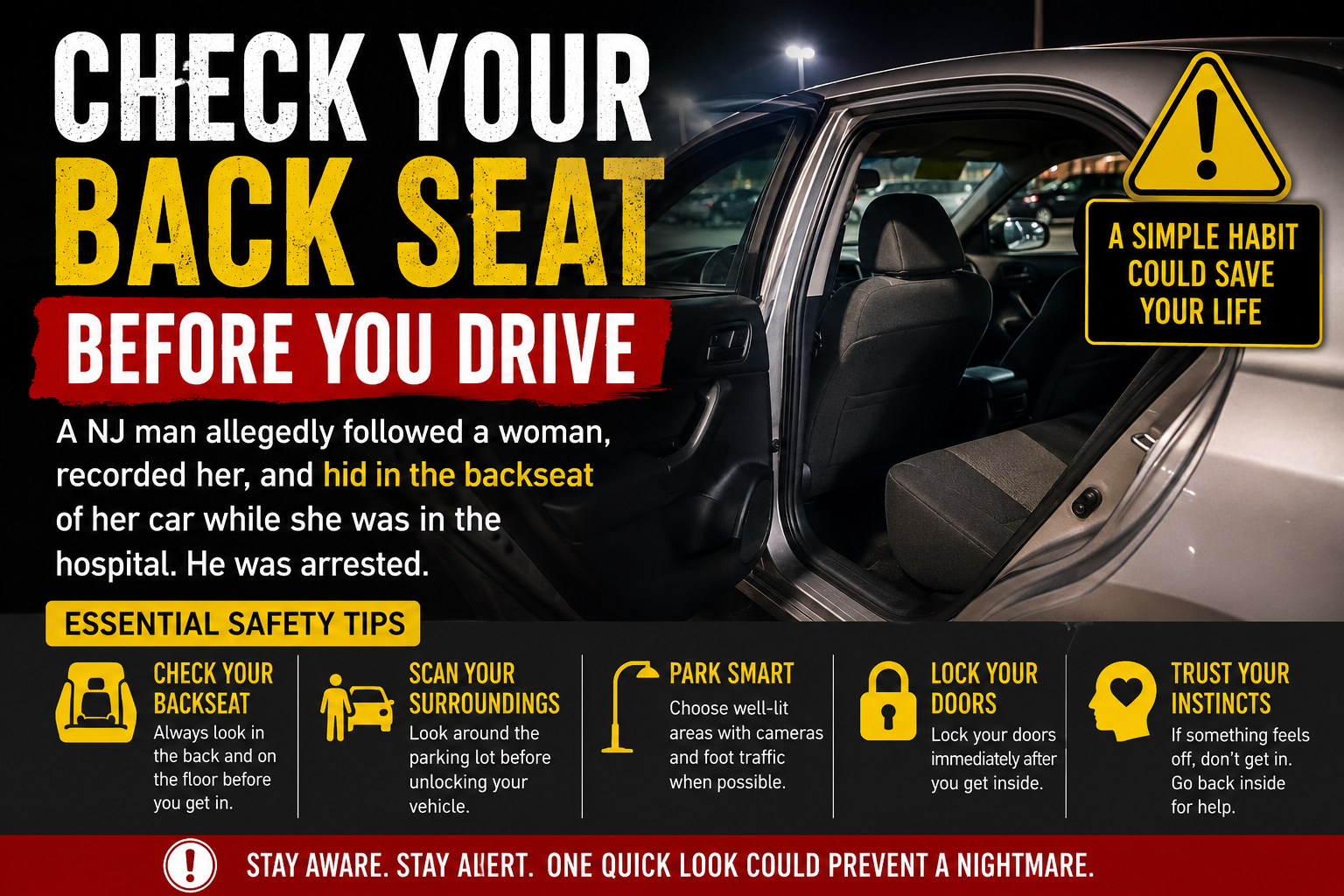
  • Why Experts Say You Should Always Check Your Back Seat Before Driving

    A disturbing stalking case out of Delaware is putting vehicle safety back in the spotlight, and it involves a 22-year-old man from Piscataway, New Jersey.

    According to Middletown, Delaware Police, the man allegedly followed a woman across state lines, secretly recorded her, and then hid in the backseat of her car while she was inside a hospital emergency room.

    Hospital security reportedly spotted him on camera sitting inside the vehicle and alerted police. He was arrested at the scene and charged with burglary and stalking.

    Thankfully, no one was physically hurt.

    But the incident has many people asking the same question: how often do we actually check our back seat before driving?

    A Simple Habit That Could Save Your Life

    Safety experts and law enforcement recommend making it a routine to check your backseat and floor area every time before getting into your vehicle.

    Criminals often target people who are distracted, exhausted, stressed, or rushing through their day. Exactly the kind of situation many people are in while leaving work, shopping centers, or hospitals.

    Taking just a few extra seconds to stay alert could potentially prevent a dangerous situation.

    Essential Vehicle Safety Tips

    Always Check Your Backseat

    Before getting in your vehicle, quickly glance into the backseat and floor area to make sure nobody is hiding inside.

    Scan Your Surroundings

    Look around the parking lot before unlocking your vehicle. Pay attention to anyone lingering nearby or acting suspiciously.

    Park Smart

    Whenever possible, choose well-lit parking spots near entrances, security cameras, or areas with steady foot traffic.

    Lock Your Doors Immediately

    As soon as you get inside your vehicle, lock the doors before checking your phone, adjusting music, or getting settled.

    Trust Your Gut

    If something feels off, listen to your instincts. Go back inside, ask security for help, or call someone you trust.

    Awareness Matters

    These safety habits take less than 10 seconds, but they can make a massive difference.

    This recent case is a sobering reminder that staying aware is not about living in fear. It’s about staying alert and protecting yourself.

    One quick glance could make all the difference.

    💬 Do you already check your backseat before driving, or is this something you’ll start doing now?

  • Needle-Free Epinephrine Is Coming: What neffy® Means for First Responders and Schools

    A recent discussion surrounding New Jersey’s proposed legislation allowing police officers to carry epinephrine auto-injectors has brought attention to a newer form of emergency treatment: neffy®, a needle-free epinephrine nasal spray.

    As conversations around emergency response evolve, neffy is being viewed by some as a potential next step in how severe allergic reactions are treated in public settings.


    What is neffy®?

    neffy is a nasal spray form of epinephrine, the same medication found in EpiPens and similar auto-injectors used to treat anaphylaxis.

    Instead of requiring an injection into the thigh, neffy is administered as a spray into the nostril.

    It received FDA approval in August 2024 for adults and children weighing at least 33 pounds (15 kg). Like traditional epinephrine devices, it is packaged in two single-use doses in case symptoms persist and a second dose is needed.


    Why it’s gaining attention

    Anaphylaxis is a fast-moving medical emergency. Symptoms such as airway swelling, difficulty breathing, and a drop in blood pressure can become life-threatening within minutes.

    Epinephrine is the primary treatment, but timely administration is critical.

    A needle-free option may help reduce hesitation in emergency situations. It also simplifies the process for individuals who may not be familiar or comfortable with injectable devices.


    Relevance for first responders

    Police officers, EMS personnel, and school staff are often the first to encounter medical emergencies in the community.

    Many are already trained to administer medications like naloxone (Narcan), which is also delivered as a nasal spray. Because of this, neffy could fit into existing response protocols with minimal adjustment.

    While New Jersey’s current legislation focuses on traditional epinephrine auto-injectors, the emergence of nasal delivery systems may influence future discussions around training and equipment.


    Current status

    As of April 2026:

    • neffy is available in the United States by prescription
    • School access programs are being introduced in some areas
    • Broader adoption among first responders is still in early stages

    Any widespread implementation would depend on policy updates, funding, and training at the state and local levels.


    Final thoughts

    Epinephrine remains a critical tool in treating severe allergic reactions. Advances in how it is delivered may improve accessibility and ease of use, particularly in high-pressure situations.

    As states like New Jersey evaluate how first responders are equipped, innovations such as neffy may become part of the broader conversation around emergency preparedness.

  • Optimus for Veterans: A Disabled Veteran’s Idea for Humanoid Robots as Assistive Companions

    My name is Andrew Gibson. I am a 100% service-connected disabled veteran.

    Like many veterans, I face daily challenges that make simple tasks more difficult than they should be. There are times when basic things, getting items I need, handling reminders, or managing light household chores, become overwhelming.

    Service dogs provide tremendous support for many veterans, but they are not an option for everyone due to long waitlists, housing restrictions, allergies, and ongoing care costs.

    That’s why I believe general-purpose humanoid robots, particularly Tesla’s Optimus, could become a valuable new tool for disabled veterans seeking greater independence.


    What Optimus Could Offer Veterans

    Tesla is preparing to start low-volume production of Optimus Gen 3 in summer 2026, with wider availability expected in 2027. The company’s long-term goal is to make these robots capable and affordable, with a target price eventually dropping toward $20,000 to $30,000 at high volume.

    A humanoid robot like Optimus has the potential to assist with practical, everyday needs such as:

    • Retrieving items when mobility or energy is low
    • Providing medication or appointment reminders
    • Helping with light household tasks
    • Offering consistent, non-judgmental support without fatigue

    This is not about replacing human connection or service animals. It is about adding a reliable, scalable option that can grow in capability as the technology improves.


    My Plan: The Veterans Humanoid Assistance Program

    I am working to create the Veterans Humanoid Assistance Program, a veteran-led initiative to help bring this technology to disabled veterans.

    The plan is straightforward and phased:

    • Form a 501(c)(3) nonprofit and assemble a small board of advisors
    • Begin with a small pilot using currently available assistive technology to gather feedback from fellow veterans
    • Apply for VA funding, especially the Specially Adapted Housing Assistive Technology (SAHAT) Grant, which supports innovative tools that help severely disabled veterans live more independently
    • Prepare to acquire or lease early Optimus units or similar platforms once they become available to organizations in late 2026 or 2027

    As the founder and a 100% disabled veteran, I plan to serve as Executive Director. Once initial funding is secured, I intend to draw a modest, reasonable salary so I can dedicate the necessary time to building and running the program.


    Why This Matters

    This effort is personal for me. My own experiences as a disabled veteran motivate me to turn challenges into something that might help others.

    If you’re a fellow veteran, a family member, someone working in assistive technology or robotics, or simply a supporter who believes in this idea, I would welcome hearing from you.

    You can reach me at:
    gibson68w@gmail.com


    Humanoid robots are moving from prototypes to reality faster than most expected. My hope is that disabled veterans can be part of that future in a meaningful way.

    Thank you for reading.

    Andrew Gibson
    100% Disabled Veteran
    Founder, Veterans Humanoid Assistance Program

  • From Dorm Room to Digital Empire: How Facebook Was Born on February 4, 2004

    On a cold February night in 2004, inside a cramped Harvard dorm room, a 19-year-old computer science student pressed “launch” on a website that would change the world.

    The site was called TheFacebook.com.

    What began as a simple online directory for Harvard students would go on to reshape communication, media, politics, business, and daily life for billions of people. Today, Facebook’s parent company, Meta Platforms, connects nearly four billion users across its apps and stands as one of the most powerful technology companies in history.

    But on February 4, 2004, it was just a dorm-room project.

    The Spark: Before Facebook Existed

    Mark Zuckerberg’s path to Facebook was already paved with code. Raised in Dobbs Ferry, New York, he showed an early aptitude for programming, creating messaging software for his father’s dental office and later developing music recommendation software that caught the attention of major tech companies.

    While attending Harvard in 2003, Zuckerberg built Facemash, a controversial site that allowed students to compare classmates’ photos in a “hot or not” format. The site drew massive attention almost immediately, but it was quickly shut down due to privacy concerns.

    Despite the backlash, Facemash revealed something important: students were eager for a centralized digital social space.

    Harvard already produced printed “face books” containing student photos and information. Zuckerberg believed a digital version could be built faster, better, and more efficiently.

    So he started coding.

    February 4, 2004: The Launch

    TheFacebook went live exclusively for Harvard students with a university email address. Within 24 hours, roughly 1,200 to 1,500 students had signed up. Within weeks, it had spread across campus.

    The early version was simple:

    • Personal profiles with photos
    • Relationship status options
    • Interests and affiliations
    • Messaging and friend requests

    There was no News Feed yet. No ads. No algorithm. Just a clean, searchable social directory.

    By the end of the month, more than half of Harvard undergraduates were active users.

    Expansion followed quickly. Other Ivy League schools joined within weeks, and by summer 2004 the team relocated to Palo Alto. What began as a student project was now a startup.

    Explosive Growth and Defining Features

    By the end of 2004, Facebook reached one million users, becoming one of the fastest-growing websites of its time.

    Key developments followed:

    • 2005: The company dropped “The” from its name and opened to high schools
    • 2006: Facebook opened to the general public
    • 2006: The News Feed launched, fundamentally changing how people consumed information
    • 2009: The Like button debuted, reshaping online engagement
    • 2012: Facebook went public and acquired Instagram
    • 2014: WhatsApp and Oculus joined the ecosystem

    Each innovation pushed Facebook deeper into daily life, turning it into both a social platform and an advertising powerhouse.

    A Platform That Changed Society — For Better and Worse

    Facebook became a tool for global connection and organization. It played a role in political movements, business growth, disaster response, and online communities.

    At the same time, its scale brought consequences:

    • Privacy scandals involving user data
    • The spread of misinformation
    • Mental health concerns tied to social media use
    • Antitrust scrutiny and regulatory pressure worldwide

    Zuckerberg and Meta faced lawsuits, congressional hearings, and historic fines, but the platform’s influence only continued to grow.

    Facebook Today

    As of 2026:

    • Meta serves nearly 4 billion monthly users
    • Facebook alone exceeds 3 billion users
    • Advertising revenue dominates the digital economy
    • The company invests heavily in AI, virtual reality, and next-generation platforms

    From dorm-room code to global infrastructure, Facebook’s rise remains one of the most consequential stories in modern technology.

    The Bigger Lesson

    February 4, 2004 wasn’t just the launch of a website. It marked the beginning of a new era of digital life, where online identity, connection, and influence became inseparable from the real world.

    Facebook’s story is both an innovation success and a cautionary tale. It shows how quickly a simple idea can scale, and how powerful technology becomes when it embeds itself into everyday human behavior.

    It all started with one student, one laptop, and a belief that something better could be built faster.

    And the world has been scrolling ever since.

  • TrumpRx.gov. How to Get Lower Prescription Drug Prices in the U.S. (2026 Guide)

    Prescription drug prices remain one of the biggest financial stress points for Americans, especially for people paying out of pocket. In early 2026, the federal government launched TrumpRx.gov, a new platform designed to help consumers access significantly lower prices on select brand-name medications.

    The program focuses on transparency, cash pricing, and international price parity. It is particularly useful for uninsured, underinsured, or self-pay patients dealing with high-cost medications for weight loss, diabetes, fertility, arthritis, respiratory conditions, and more.

    This guide explains what the program is, how it works, and who benefits most.


    What Is TrumpRx.gov?

    TrumpRx.gov is a government-run prescription price portal. It does not sell medications directly and does not require creating an account. Instead, it functions as a centralized lookup tool that shows discounted cash prices for specific brand-name drugs.

    The pricing model is based on “Most-Favored-Nation” standards. In simple terms, that means U.S. patients are offered prices comparable to what patients pay in other developed countries, rather than the higher domestic list prices that are common in the American market.

    The platform allows users to:

    • View cash-pay prices without insurance
    • Download or print pharmacy coupons
    • Access manufacturer direct-purchase options
    • Compare discounted prices against typical list prices

    A valid prescription from a healthcare provider is still required.


    How the Program Works

    Using the platform is straightforward:

    1. Search for a medication by name or browse the available list
    2. Review the discounted cash price shown under MFN benchmarks
    3. Choose how to redeem the savings, either at a pharmacy or through a manufacturer channel
    4. Present your prescription to complete the purchase

    The system is designed for self-pay use. Patients with insurance should compare these prices against their plan’s copays or coverage, as insurance may still be cheaper in some cases.


    Medications and Savings Available

    At launch, the program included more than 40 brand-name medications through agreements with over a dozen pharmaceutical companies. Discounts vary by drug, dosage, and manufacturer, but many fall in the 50 to 90 percent range off typical list prices.

    Some of the largest savings appear in categories that historically have limited insurance coverage, including:

    Weight Loss and Diabetes Medications

    • Injectable and oral GLP-1 drugs offered at a fraction of standard retail pricing
    • Monthly costs reduced from four figures to a few hundred dollars in many cases

    Fertility Medications

    • Certain fertility treatments discounted dramatically compared to traditional pharmacy pricing

    Respiratory, Arthritis, and Specialty Drugs

    • Inhalers, autoimmune therapies, and specialty medications with substantial price reductions

    Not every drug is included, and availability can change as new agreements are added.


    Who Benefits Most from TrumpRx.gov?

    The platform is most valuable for:

    • Uninsured individuals paying full retail prices
    • Underinsured patients facing high deductibles or copays
    • People prescribed brand-name drugs not covered by insurance
    • Patients who prefer cash pricing to avoid insurance restrictions

    For those on Medicare, Medicaid, or comprehensive employer plans, existing coverage may still offer lower net costs. Comparing options remains important.


    Tips to Maximize Savings

    • Check the platform periodically, as new medications are added over time
    • Talk with your doctor about whether a listed medication is appropriate for you
    • Compare the listed cash price against insurance copays and other discount programs
    • Pay attention to dosage and quantity details, as pricing can vary

    Prices are set by manufacturer agreements and may change.


    The Bottom Line

    TrumpRx.gov is not a complete solution to U.S. prescription drug pricing, but it does provide meaningful relief for many patients who pay out of pocket. By offering transparent, internationally aligned pricing and direct access to discounts, it fills a gap that has long existed for self-pay consumers.

    For Americans struggling with the cost of essential medications, it is a tool worth understanding and revisiting as the program expands.

  • Alex Honnold’s Taipei 101 Free Solo: Respect the Feat, But It Didn’t Hit Like El Cap

    First off, full respect to Alex Honnold. On January 25, 2026 (local time), he free-soloed Taipei 101 during Netflix’s live Skyscraper Live broadcast. No ropes. No harness. No backup. At 40 years old, he climbed roughly 1,667 feet in about an hour and a half, took a summit selfie in the wind, called it “sick,” and came down safely.

    That alone deserves respect. One mistake at that height and it’s over. I couldn’t do it. Most people couldn’t. Pulling it off live, with the world watching, takes an elite mental game.

    But here’s the honest take: watching it didn’t land the way his El Capitan free solo did. Not even close.

    Why It Felt Different

    Taipei 101 is not a sheer, featureless glass monolith. It’s a bamboo-inspired, pagoda-style structure made up of stacked sections with overhangs, ledges, and repeating architectural elements. Honnold himself described the climb as a repeating rhythm of “easy, easy, hard,” over and over again.

    Those design features matter.

    Every few floors, there were horizontal balconies and no-hands rest spots where he could shake out, recover, and reset. The facade offered predictable seams, panel edges, sidepulls, and protrusions that repeated consistently. This wasn’t chaotic, natural rock where conditions change move to move. It was engineered, symmetrical, and forgiving.

    Instead of a relentless vertical fight, it felt more like a long endurance effort broken into manageable pitches.

    The Ladder Question

    Then there’s the spire.

    Near the top, Honnold transitioned onto a free-swinging ladder installed for maintenance because parts of that narrow overhang are essentially impossible to climb directly. Commentators acknowledged the ladder was necessary. That matters.

    Using a ladder doesn’t negate the climb. But it does change the nature of the risk. A slip near the end doesn’t mean a full-height free fall. You’re close to observation decks and mechanical levels. There’s a built-in margin that simply doesn’t exist on natural big wall free solos.

    Context Matters

    Compare this to El Capitan, where Honnold faced unpredictable granite, microscopic smears, real cruxes, and zero engineered recovery zones. That climb felt raw, unforgiving, and existential in a way Taipei 101 just didn’t.

    Or compare it to Alain Robert, who climbed Taipei 101 back in 2004 with ropes and safety gear because authorities required it. Robert has long said skyscrapers are often safer and simpler than natural rock. Watching this, it’s hard to argue otherwise.

    Taipei 101 is almost the perfect building for a stunt like this. Repeating patterns. Generous ledges. Predictable holds. Earthquake- and typhoon-engineered features that just happen to make it climbable.

    The Bottom Line

    This isn’t about saying it was easy. It wasn’t. The exposure is terrifying. The commitment is real. Honnold is still operating at a level almost no one else on Earth can touch.

    But the headlines oversold the danger compared to what was actually happening on the wall. The building did a lot of the work. It was impressive, but not mind-blowing.

    Judging by quiet chatter online, I don’t think I’m alone in feeling this way. Plenty of climbers and viewers respect the achievement while privately admitting it didn’t hit like El Cap. Buildings are engineered. Rock is not.

    Congrats to Honnold. He’s a legend.

    But for me, this one was more fascinating than jaw-dropping.

  • How Cold Is Too Cold for Your Pets?

    https://www.wellnesspetfood.com/wp-content/uploads/2024/01/paw.jpg

    When temperatures drop into the teens, especially around 13°F, conditions move beyond uncomfortable and into dangerously cold territory for pets. At this level of cold, it is not safe to leave dogs or other pets outside for extended periods, regardless of breed.

    Cold exposure at these temperatures significantly increases the risk of hypothermia and frostbite, particularly affecting paws, ears, tails, and noses. Pets should not be left outdoors unsupervised or for long stretches in these conditions. The safest approach during extreme cold is to bring pets indoors as much as possible.

    That said, pets still need brief outdoor time for bathroom breaks or short walks. The key is keeping those outings short, supervised, and adjusted to the individual animal.


    How Long Is Too Long in Extreme Cold?

    There is no single safe time limit. Cold tolerance varies based on size, coat type, age, health, and acclimation to winter weather. Wind, moisture, and lack of shelter can make cold exposure much more dangerous.

    Below are conservative guidelines for brief, supervised outings only. These are not recommendations for leaving pets outdoors.

    Small pets and small dogs (under 20–25 pounds or thin-coated breeds):
    10–15 minutes at most, often less. Very small or short-haired animals may tolerate only a few minutes and should return indoors quickly.

    Medium-sized dogs (25–50 pounds):
    About 15–20 minutes maximum, with many better limited to closer to 10–15 minutes when temperatures are below 20°F.

    Large dogs (50 pounds and up, thicker coats):
    Up to 20–30 minutes if active, though even cold-hardy breeds are not immune to frostbite or hypothermia and should not remain outside for long.

    No pet should sleep outdoors or remain outside for prolonged periods in these temperatures.


    Pets That Need Extra Caution

    Some pets are at higher risk and should have much shorter outdoor exposure, often half the time or less:

    • Puppies and kittens
    • Senior pets
    • Thin or lean animals
    • Pets with arthritis, heart conditions, or other medical issues

    For these animals, even brief cold exposure can be dangerous.


    Cold Weather Safety Tips for Pet Owners

    • Keep pets indoors during extreme cold whenever possible
    • Limit outdoor time to quick bathroom breaks
    • Consider insulated coats or booties for short outings
    • Wipe paws after going outside to remove ice and road salt
    • Watch closely for warning signs like shivering, lifting paws, slowing movement, or seeking warmth
    • Never leave pets tied out or unattended in freezing weather

    If a pet shows signs of cold stress, bring them inside immediately and warm them gradually, not rapidly.


    The Bottom Line

    At 13°F, it is simply too cold for extended outdoor time. Even short outings should be brief, supervised, and adjusted to the individual pet.

    When in doubt, assume it is too cold. Your pet’s safety and comfort should always come first.

  • Exploding Trees Are Real. Here’s What’s Actually Happening and Whether It Can Occur in New Jersey

    Reports of “exploding trees” tend to surface during extreme winter cold, often paired with accounts of loud booms echoing through forests at night. While the phrase sounds exaggerated, the phenomenon behind it is real and well documented. It is not an explosion in the traditional sense, but a cold-weather process known as frost cracking, sometimes referred to as a frost burst.

    Understanding what causes it, where it occurs, and whether it poses a real risk in New Jersey helps separate fact from viral exaggeration.


    What Are “Exploding Trees,” Really?

    So-called exploding trees are the result of frost cracks, long vertical splits that form in tree trunks during periods of intense cold.

    The process works like this:

    • Trees contain moisture and sap within their internal tissues
    • When temperatures drop rapidly, that moisture freezes
    • As water freezes, it expands, creating internal pressure
    • The outer bark cools and contracts faster than the inner wood

    When the stress becomes too great, the trunk splits suddenly. The release of pressure can produce a sharp cracking or popping sound, often compared to a gunshot or rifle crack. This is why reports frequently come from nighttime hours during deep freezes, when temperature drops are fastest and background noise is minimal.

    Frost cracking most commonly affects trees with thinner bark, including:

    • Maple
    • Oak
    • Birch
    • Sycamore
    • Fruit trees

    The cracks can stretch several feet vertically and, in some cases, be wide enough to expose inner wood.


    Can This Happen in New Jersey?

    Yes. Frost cracking can occur in New Jersey, though it is far less common than in regions where sub-zero temperatures are routine.

    Current weather context:
    As of late January 2026, New Jersey is bracing for a sharp cold snap this weekend (January 24–26), with daytime highs in the teens to low 20s and overnight lows in the single digits to around 10°F. Some inland and northern areas could briefly dip near 0°F, with wind chills falling below zero. This is dangerously cold for people, pets, and pipes, but still below the threshold typically associated with widespread frost cracking, which usually requires sustained air temperatures in the –10°F to –20°F range.

    That said, isolated frost cracks are still possible under the right conditions.

    Risk factors in New Jersey include:

    • Polar vortex events or Arctic outbreaks
    • Rapid temperature drops following sunny winter days
    • South- or southwest-facing tree trunks, which absorb more sunlight during the day and cool rapidly at night

    Northern and inland areas such as Sussex and Warren counties are more susceptible than coastal regions, where ocean moderation limits extreme lows. While widespread “exploding tree” events are unlikely here, individual cases can occur during sharp cold snaps.


    What Kind of Damage Can Frost Cracks Cause?

    A frost crack is not automatically fatal to a tree, especially if it is otherwise healthy. However, it does create a structural and biological vulnerability.

    Potential consequences include:

    • Open wounds that allow insects, fungi, and bacteria to enter
    • Internal decay, which weakens the tree over time
    • Higher risk of limb or trunk failure during snow, ice, or wind storms
    • Recurring splits, as old cracks often reopen during future cold events

    Young trees and stressed trees are most at risk. In severe cases, frost cracks can lead to cankers, fungal infections that interfere with nutrient flow and may eventually kill the tree.

    Many trees partially heal during warmer months by forming new bark tissue, but scars typically remain and can reopen in later winters.


    Can Frost Cracks Be Prevented?

    Frost cracking cannot be completely prevented, but the risk can be reduced, especially for young or ornamental trees.

    Common protective steps include:

    • Wrapping trunks with burlap or tree wrap in winter
    • Using reflective guards to reduce daytime sun heating
    • Avoiding late-season pruning that stresses trees before cold weather

    If a fresh crack appears, arborists generally recommend monitoring rather than sealing, as improper sealing can trap moisture and worsen decay. Professional evaluation is advised if the tree is near homes, vehicles, or walkways.


    The Bottom Line

    Exploding trees are not a myth, but they are also not a common hazard in New Jersey. The loud cracking sounds reported during extreme cold are the result of wood splitting under thermal stress, not combustion or collapse.

    While this weekend’s deep freeze is serious and potentially dangerous, it is unlikely to trigger widespread frost cracking unless temperatures plunge significantly lower or remain sub-zero for extended periods. Still, isolated cases are possible, especially in exposed or inland areas.

    If a sharp crack echoes through the woods on a bitter night, it may not be fireworks. It may just be winter doing what winter does.

  • Why NJ Transit Feels So Unreliable

    The Real Reasons Behind Delays, Cancellations, and Rider Frustration

    (Evergreen Guide. Updated January 2026)

    If you have ever waited on an NJ Transit platform for a train that was delayed again, canceled without warning, or showed up overcrowded and uncomfortable, you are not alone.

    NJ Transit moves hundreds of thousands of riders every day. Mostly commuters heading to and from New York City. Despite its size and importance, it has developed a reputation as one of the least reliable major commuter rail systems in the country.

    This is not just bad luck or commuter exaggeration. The problems are structural, long-standing, and well documented. They come from aging infrastructure, operational dependencies, funding gaps, and system design choices that compound delays.

    Here is what is actually behind NJ Transit’s reliability issues.


    1. Aging Infrastructure and Decades of Deferred Maintenance

    Much of NJ Transit’s rail network relies on infrastructure built decades ago. In some cases, more than a century old.

    Major problem areas include:

    • Overhead catenary wires and signal systems
      These systems are highly sensitive to weather. Heat causes expansion in summer. Ice causes failures in winter. Breakdowns often cascade across multiple lines.
    • The Portal Bridge bottleneck
      The 115-year-old swing bridge over the Hackensack River is one of the worst chokepoints on the Northeast Corridor. It opens for marine traffic and frequently malfunctions.
      The Portal North Bridge replacement is underway, but early 2026 construction phases have required temporary service reductions of roughly 50 percent on some schedules. Long-term gains come with short-term pain.
    • An aging train fleet
      Many locomotives and rail cars are 30 to 50 years old. NJ Transit relies heavily on single-locomotive trains. One failure often means an entire trip is canceled. Systems with distributed power have more redundancy.

    The result is a system that experiences far more mechanical cancellations than comparable railroads.


    2. Dependence on Amtrak’s Northeast Corridor

    NJ Transit does not control its most important tracks.

    The Northeast Corridor is owned and dispatched by Amtrak. NJ Transit shares it with high-priority Amtrak services like Acela and Northeast Regional trains.

    This creates several issues:

    • Amtrak trains are often prioritized during disruptions.
    • Bottlenecks like the Hudson River tunnels magnify even small delays.
    • Signal failures, brush fires, or Amtrak equipment issues ripple directly into NJ Transit service.

    Few major commuter railroads in the U.S. are this dependent on another operator’s infrastructure. That dependency makes NJ Transit especially vulnerable to cascading delays.


    3. Chronic Underfunding and Budget Pressure

    NJ Transit’s financial struggles did not start recently. They span multiple administrations.

    Key factors include:

    • Capital funds repeatedly diverted to cover operating costs.
    • Delayed fleet replacement and infrastructure upgrades.
    • Workforce shortages, especially engineers and maintenance staff.
    • Fare increases used to stabilize budgets without corresponding service improvements.

    While recent funding efforts and federal grants have helped, the system still operates with a structural gap. Preventive maintenance and long-term planning have suffered as a result.


    4. On-Time Performance and Cancellation Reality

    Official NJ Transit data often shows on-time performance in the 80 to 90 percent range. However, that number typically excludes Amtrak-related delays.

    Independent analyses tell a different story:

    • NJ Transit experiences significantly more severe delays of 30 minutes or longer than regional peers.
    • Mechanical cancellations remain higher than comparable systems.
    • Rider satisfaction surveys consistently cite reliability and communication as the top complaints.

    For riders, the experience often feels worse than the numbers suggest because cancellations cluster during peak hours when alternatives are limited.


    5. Other Contributing Factors Riders Feel Every Day

    Several additional issues make delays feel more frustrating than they might otherwise be:

    • Weather sensitivity. Heat waves, cold snaps, and storms disproportionately impact NJ Transit.
    • Communication gaps. Riders often receive delayed or unclear updates during disruptions.
    • Overcrowding. When one train is canceled, remaining trains absorb more riders, worsening conditions.
    • Bus and light rail variability. Buses face traffic congestion, while light rail systems have their own maintenance issues.

    These factors combine to create the sense that things are always going wrong, even when the root cause is not obvious.


    What Is Being Done and What Comes Next

    There are real improvements underway:

    • New multilevel rail cars are expected to begin entering service in mid-2026.
    • Portal North Bridge and Gateway Program projects aim to remove major chokepoints.
    • Positive Train Control implementation is complete.
    • Workforce rebuilding is in progress.

    The problem is timing. These fixes take years, not months.


    Practical Tips for NJ Transit Riders

    Until reliability improves, riders can reduce frustration by:

    • Using NJ Transit alerts and real-time tracking tools.
    • Building buffer time into commutes, especially for NYC travel.
    • Knowing alternative routes such as PATH, buses, or park-and-ride options.
    • Reporting issues through official channels. Complaints do influence planning and funding decisions.

    The Bottom Line

    NJ Transit’s reliability problems are not random. They are the result of infrastructure age, shared control with Amtrak, long-term funding gaps, and system design constraints.

    The system still moves millions of people safely every year. But until major projects are completed and funding stabilizes, delays and cancellations will remain part of daily life for many riders.

    If you ride NJ Transit regularly, you are not imagining it. And you are not alone.

    What is your biggest NJ Transit pain point? Reliability, communication, overcrowding, or something else.

    For the recurring infrastructure and operating problems behind rail disruptions, see why NJ Transit trains get delayed and what riders can do.

    Related reading