
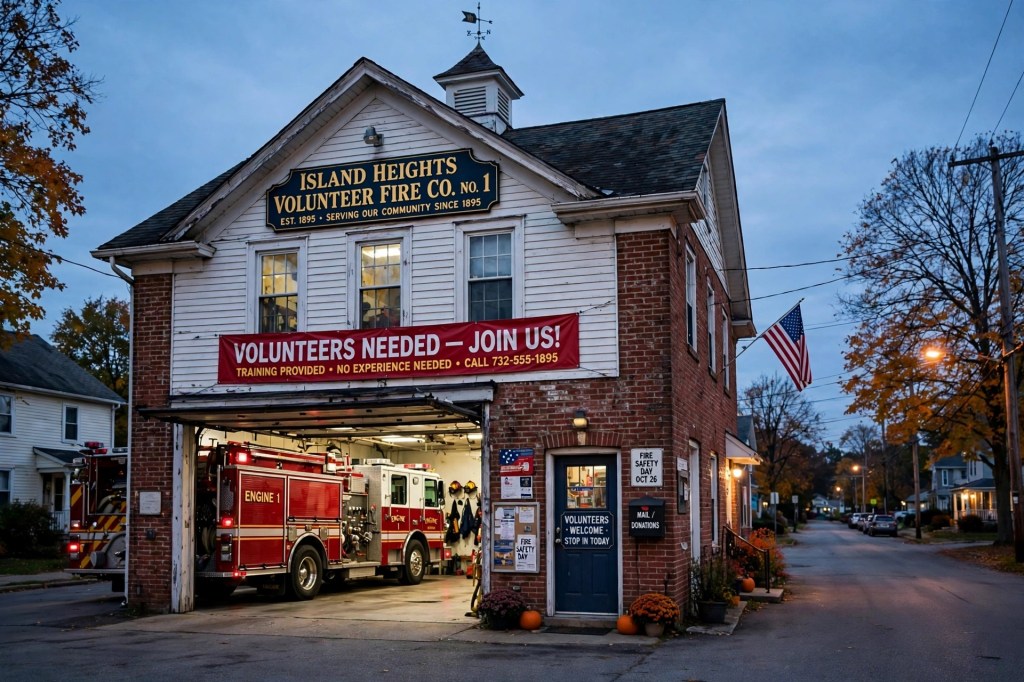
Demand case
People search this one when it stops being abstract: “why did my firehouse close,” “NJ volunteer firefighter shortage,” and “is EMS an essential service in New Jersey.” I searched for a clean, sourced monthly search volume for those exact questions and did not find one I could stand behind, so I am stating it plainly here: no clean volume exists in the sources I checked, and I am not inventing one. The demand case is in the record itself. The Legislature created a task force by law to study this problem, the New Jersey League of Municipalities maintains a standing page on the decline, and the Senate Legislative Oversight Committee held a full hearing on volunteer EMS on October 8, 2026, because towns are losing crews faster than they can replace them.
I know how this used to work
I was a firefighter in Point Pleasant Borough. The old model was simple. You lived in town, you worked in or near town, the pager went off, and enough people showed up. Your father did it, so you did it. The firehouse was part of the town, not a service the town purchased.
That model is breaking, and not because people got selfish. The job got bigger, the training got longer, the calls got more frequent, and the rest of life got more expensive. The state has documented that in its own report, in league guidance to mayors, and in committee testimony this fall. When volunteers cannot cover the call, a town has three choices, and all of them cost somebody something: pay a crew, consolidate houses, or wait longer for help from farther away.
What the state task force actually found
New Jersey created the Special Task Force on Volunteer Retention and Recruitment by state law on January 16, 2018. Its final report is dated December 2023. The chair was Joseph Hankins, the representative of the New Jersey State Firemen’s Association.
The report states the core finding plainly: there is growing concern across the state that volunteer first responder organizations are unable to retain and recruit members, leading to a decline in volunteer first responders, and when fewer people volunteer, municipalities are forced to hire paid personnel at the expense of taxpayers.
Nationally, the report cites United States Fire Administration figures that nearly 70 percent of all firefighters in the nation are volunteers, while the number of volunteer firefighters fell from 897,750 in 1984 to 676,900 in 2020. The New Jersey League of Municipalities cites the same drop and adds the other half of the squeeze: while volunteers have decreased, the number of calls volunteer companies receive has increased, and in emergency situations, response time is everything.
The League lists why: people move away, parents are booked solid with kids activities, certification takes time and money before a volunteer answers one call, and every other good cause wants the same free hours. The League also states a fact that shapes the EMS side: New Jersey does not consider EMS an essential service. Only police, fire, and garbage are considered essential. In 2022, the League adopted a resolution supporting EMS as an essential service. Think about that. The ambulance is not essential on paper. The trash truck is.
The 2026 Senate hearing put fresh numbers on it
On October 8, 2026, the Senate Legislative Oversight Committee took testimony on volunteer EMS. Kari Phair of the EMS Council of New Jersey testified that the Council represents more than 190 volunteer squads who operate approximately 460 ambulances and collectively responded to more than 180,000 requests for service last year. Chair Senator Andrew Zwicker noted Montgomery Township’s all volunteer service responded to almost 1,700 calls last year, accounting for almost 32,000 volunteer hours.
John Iazzetta, for the Medical Transportation Association of New Jersey, gave the number that should stop anyone cold. Prior to the pandemic, New Jersey had roughly 30,000 EMTs with up to date certifications. Today, there are only about 20,000. A state occupational survey counted only 5,630 EMTs currently employed in New Jersey, with hospitals, volunteer squads, and transport companies competing for the same burned out workforce. Dr. Scott Pasichow testified that those EMTs participate in 1.5 million incident responses every year. Phair added that new ambulances cost roughly $400,000, about twice what they did 10 years ago. The hearing also centered on Senate Bill 1421, which would recognize basic life support as an essential service.
What it looks like when a town runs out of people
Winslow Township, Camden County, shows the fire side. Chief Marc Rigberg said the 60 square mile township once had nine stations and 140 volunteer firefighters. By its 2024 consolidation announcement, it was down to just 35 volunteers, only 24 of them trained as structural firefighters. The Tansboro, Albion, and Elm stations were set to close by the end of 2024 and consolidate at headquarters on Cedar Brook Road. Rigberg said there had been times when a call came in and the department was unable to respond.
Jackson shows the end of the line. The Whitesville Volunteer Fire Company, founded in 1931 and among the companies that responded to the Hindenburg fire in 1937, ceased to exist after January 1, according to reporting published January 26, 2026. Fire District No. 2 official Scott Rauch said Whitesville calls were up 46 percent from 2016, while the district moved career staff to 24 hour coverage on July 13, 2025, and crew size dropped from four to three. It did not die in a scandal. It ran out of people who could give the time.
Collingswood is the quieter version. The borough states a volunteer has not responded to a call since 2018, modern training can include up to 250 hours and take a year or more part time, and the town transitioned to a fully paid department. A lot of people on these rosters wore a uniform before turnout gear, which is why we keep support numbers in the NJ Vet2Vet, Cop2Cop, and 988 numbers piece, and why veteran volunteers should also read NJ veterans property tax benefits.
What towns and counties are doing about it
The task force recommendations cover the serious attempts: condense training and offer virtual options for certain courses without lowering the standard, put fire and EMS programs in vocational schools and high schools, give college credit, tuition help, scholarships, and loan forgiveness for volunteers who serve a minimum term, fix Emergency Medical Technician Training Fund reimbursement, give volunteers a tax deduction or credit, and start junior programs, a statewide awareness campaign, and mentorships.
Ocean County is running the training bucket in public. Its Fire and EMS Training Center in Waretown set a goal to graduate roughly 100 new EMTs annually for 33 municipalities. Its 224 hour basic course graduated 19 certified responders from an inaugural class of 25, with the county covering cost for candidates sponsored by a local agency. A separate 430 hour program for high school seniors was set to begin in September 2026. County officials said its EMS agencies answer between 110,000 and 120,000 calls a year. Other towns buy coverage instead: daytime paid crews, per diem EMTs, county mutual aid, shared services, and full paid transitions like Collingswood. Every option shows up in a budget, a tax bill, or a response time.
If you live in a town served by volunteers, ask two questions at your next municipal meeting. How many certified people actually answered calls last month, not how many names are on the roster? And what is the plan for a weekday at 11 in the morning, when most of those people are at jobs in another town? If the answer is a shrug, you do not have a volunteer problem coming. You already have one.
For the responders reading this, save the numbers that are built for you.
NJ Vet2Vet: 1-866-838-7654
NJ Cop2Cop: 1-866-267-2267
Veterans Crisis Line: dial 988, then press 1
Sources
- Special Task Force on Volunteer Retention and Recruitment, Final Report, December 2023: https://pub.njleg.gov/publications/reports/TheSpecialTaskForceonVolunteerRetention&RecruitmentFinalReport.pdf
- New Jersey Senate Legislative Oversight Committee, hearing transcript on volunteer EMS, October 8, 2026: https://pub.njleg.state.nj.us/publications/public-hearings/26/slo10082026.pdf
- New Jersey League of Municipalities, Volunteers: EMS and Fire, accessed November 16, 2026: https://www.njlm.org/1396/Volunteers-EMS-Fire
- Jersey Shore Online via WBNJ, “Whitesville Fire Company Disbands After Nearly A Century Of Service,” January 26, 2026: https://wbnj.org/whitesville-fire-company-disbands-after-nearly-a-century-of-service/
- New Jersey 101.5 via WCHR, “Critical shortage of volunteers forces NJ fire houses to close,” May 16, 2024: https://wchram.com/ixp/385/p/critical-shortage-of-volunteers-forces-nj-fire-houses-to-close/?trackback=fbshare_mobile
- Borough of Collingswood, fire department transition explainer, accessed November 16, 2026: https://www.collingswood.com/blog_detail_T44_R593.php
- Asbury Park Press, “Ocean County launches EMS training programs amid volunteer shortage,” March 3, 2026: https://www.app.com/story/news/local/ocean-county/2026/03/03/ocean-county-nj-launches-ems-training-programs-amid-volunteer-shortage/88706725007/
- Ocean County Government, EMS Academy press release, accessed November 16, 2026: https://www.co.ocean.nj.us/frmPressReleaseDetails.aspx?Name=11104

